Capitol Complex, Chandigarh
Chandigarh
- Inscribed
- 2016
- Period
- 1952–1965
- Property
- Cultural
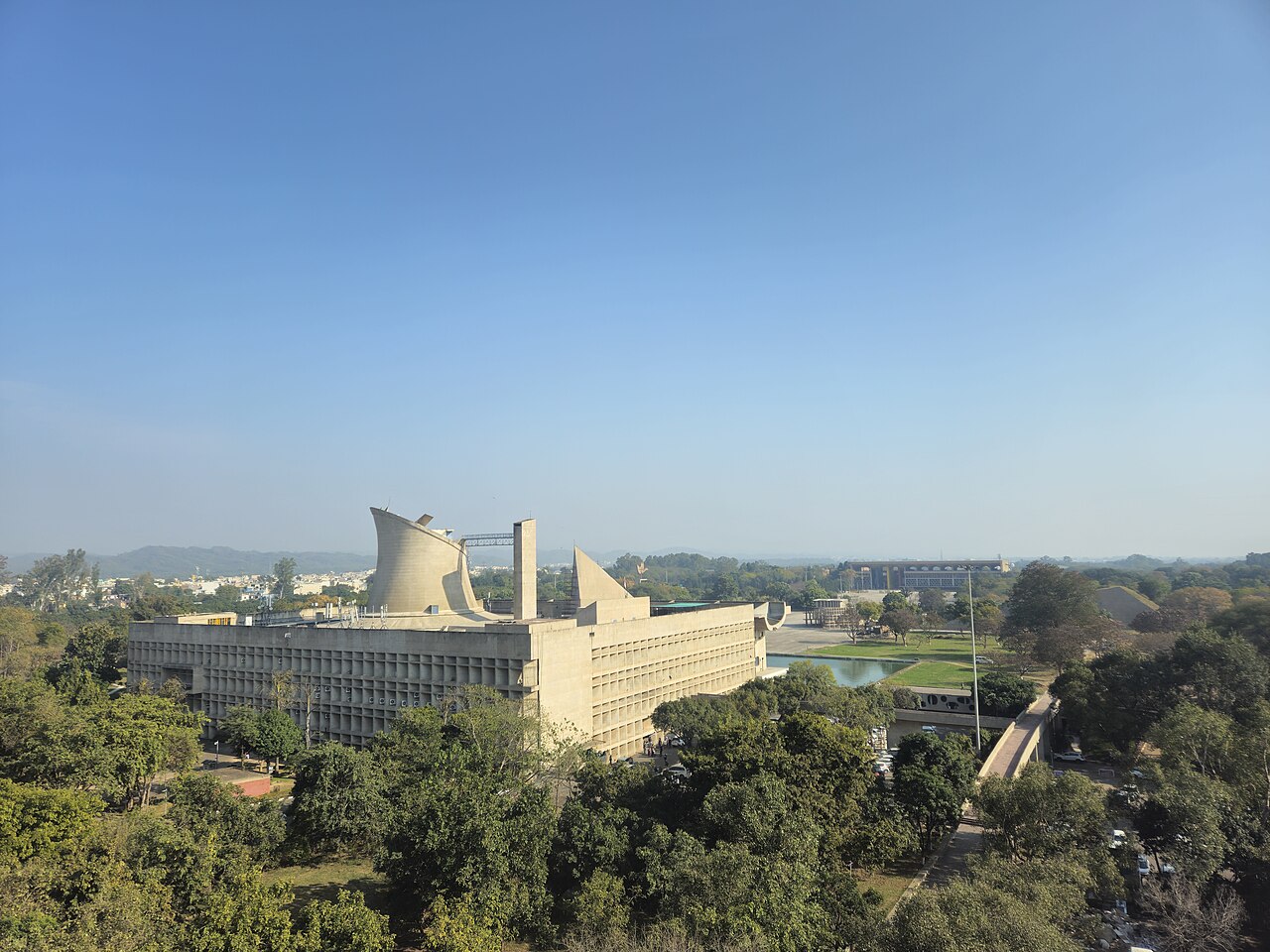
The Capitol Complex is the government precinct of Chandigarh, comprising the Palace of Assembly, the High Court, the Secretariat and a series of monuments including the Open Hand. It is the Indian component of the serial property 'The Architectural Work of Le Corbusier'.
History
After Partition, Punjab lost its capital at Lahore and a new city was planned. Albert Mayer and Matthew Nowicki produced the first scheme; after Nowicki's death, Le Corbusier was engaged in 1951, working with Pierre Jeanneret, Maxwell Fry and Jane Drew. The Capitol buildings were constructed through the 1950s and into the 1960s. The transnational property, covering seventeen sites in seven countries, was inscribed in 2016.
Architecture
The buildings are in board-marked reinforced concrete, using the vocabulary Le Corbusier developed in his late work: brise-soleil sun-breakers sized to the latitude, sculptural roof forms, and the Modulor proportional system. The High Court sits under a great parasol roof; the Assembly has a hyperbolic tower over its chamber and a sculptural portico. The Open Hand, a rotating metal sculpture, is the city's emblem.
Significance
Chandigarh is one of the few twentieth-century planned capitals realised largely as designed, and the Capitol is the fullest built statement of Le Corbusier's late architectural language. Its inclusion recognises the modern movement as heritage in its own right.
UNESCO recognition
Inscribed in 2016 as part of a transnational serial property under criteria (i), (ii) and (vi), for its creative genius, its worldwide influence and its association with the modern movement.
More views
3 images