
Ellora Caves
Aurangabad district, Maharashtra
- Inscribed
- 1983
- Period
- 6th–10th century CE
- Property
- Cultural
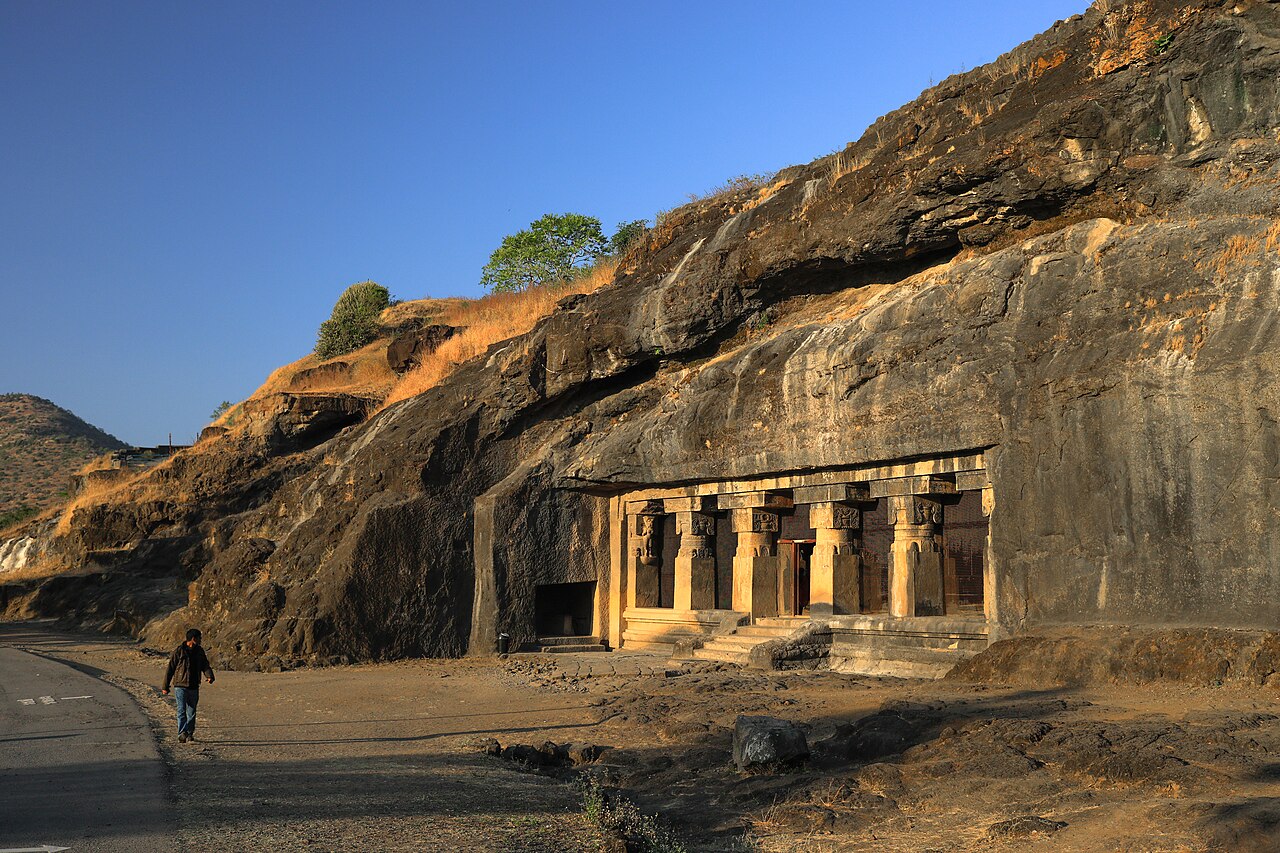
Ellora is a line of thirty-four rock-cut monasteries and temples running along a basalt escarpment in the Charanandri hills. The excavations belong to three religions — Buddhist, Hindu and Jain — cut over roughly four centuries, in places adjacent to one another. The site was never lost and has been in more or less continuous use.
History
The Buddhist caves are broadly the earliest, from around the sixth to eighth centuries; the Hindu caves overlap and continue; the Jain group is latest, into the tenth. Patronage came from successive dynasties, notably the Rashtrakutas, under whom the Kailasa temple is generally attributed to Krishna I in the eighth century. That the three traditions were cut side by side, without the earlier work being destroyed, is itself part of the record.
Architecture
Cave 16, the Kailasa temple, is the exceptional case: rather than being built up from blocks, it was excavated top-down from the living rock, removing an estimated two hundred thousand tonnes of basalt to leave a free-standing temple complex — gateway, shrine, hall, courtyard and monolithic elephants — carved as one continuous piece. The Buddhist caves include multi-storeyed viharas and the Vishvakarma chaitya with its ribbed ceiling cut to imitate timber. The Jain caves at the northern end are smaller and exceptionally finely finished.
Significance
Ellora is the largest single-rock excavation of its kind anywhere, and the clearest physical evidence of religious coexistence in early medieval India: three traditions at work on the same cliff, over centuries, with the earlier excavations left intact.
UNESCO recognition
Inscribed in 1983 under criteria (i), (iii) and (vi), as a masterpiece of creative genius, a testimony to the civilisation of ancient India, and a place associated with living religious traditions.
More views
5 images