Agra Fort
Agra, Uttar Pradesh
- Inscribed
- 1983
- Period
- 1565 onward
- Property
- Cultural
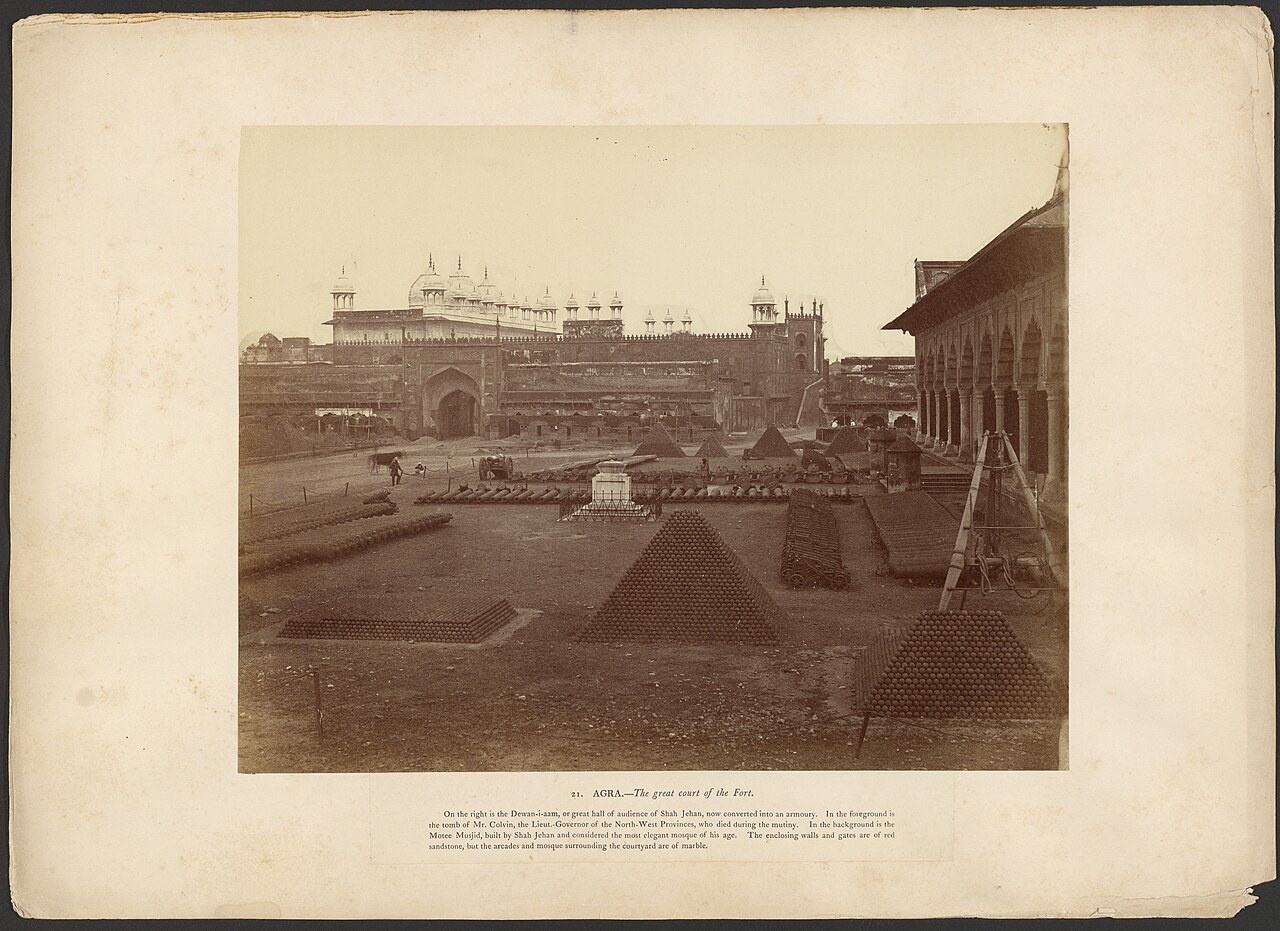
Agra Fort is a fortified imperial residence on the right bank of the Yamuna, roughly two and a half kilometres upstream of the Taj Mahal. Its walls run for some two and a half kilometres in a rough crescent, rising over twenty metres, and enclose what was effectively a city: audience halls, palaces, mosques, gardens and quarters. It served as the principal seat of the Mughal empire until the court moved to Delhi.
History
Akbar took the site in 1558 and rebuilt what had been a brick fort in red sandstone from 1565. Jahangir and then Shah Jahan altered it heavily, the latter demolishing sections of Akbar's sandstone work to build in white marble. Shah Jahan was deposed by his son Aurangzeb in 1658 and held at the fort until his death in 1666.
Architecture
The outer walls and the Delhi and Amar Singh gates are Akbar's, in dressed red sandstone with inlaid white marble patterning. Inside, the sequence runs from Jahangiri Mahal — Hindu and Central Asian forms worked together in sandstone — to Shah Jahan's marble additions: the Khas Mahal, the Sheesh Mahal with its mirror mosaic, the Diwan-i-Am for public audience and the Diwan-i-Khas for private. The Musamman Burj, an octagonal marble tower over the river, looks directly toward the Taj Mahal.
Significance
Agra Fort records the Mughal style changing in place across three reigns, from Akbar's robust sandstone syncretism to Shah Jahan's marble refinement — the two visible within a few metres of each other. It is also the clearest surviving example of the Mughal fort-palace as a working seat of government rather than a monument.
UNESCO recognition
Inscribed in 1983 under criterion (iii) as an outstanding testimony to Mughal civilisation at its height.
More views
4 images