Meenakshi Amman Temple
Madurai, Tamil Nadu
- Status
- Tentative list
- Period
- Rebuilt 16th–17th century
- Property
- Cultural
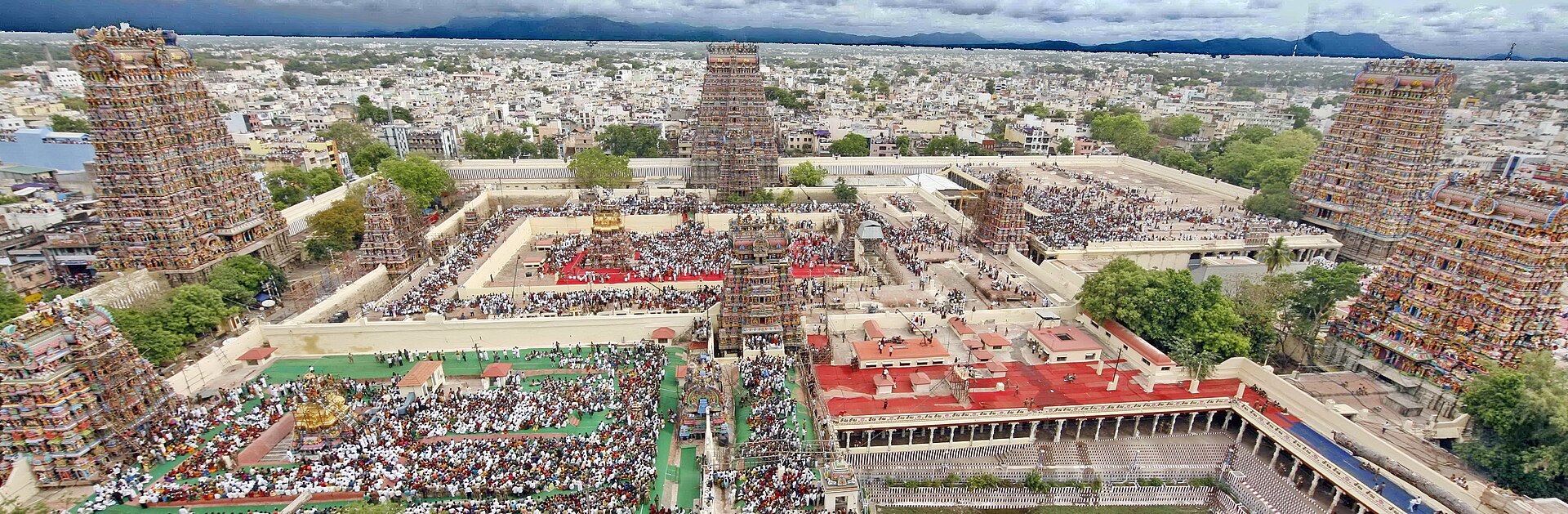
The Meenakshi Amman Temple is a historic Hindu temple located on the southern bank of the Vaigai River in Madurai. Dedicated to Goddess Meenakshi (a form of Parvati) and Lord Sundareshwar (a form of Shiva), it is one of the most important temples in Tamil Nadu and a major pilgrimage centre.
History
The original temple was built around the 6th century CE by the Pandya dynasty. The present structure was largely rebuilt in the 16th and 17th centuries by the Nayak rulers after being damaged during the Malik Kafur invasion of 1311. The temple was restored to its full glory under Thirumalai Nayak (1623–1659), who added many of the current gopurams and the musical pillars of the Vasantha Mandapam.
Architecture
The temple complex covers 14 acres and is enclosed by nine gopurams (gateway towers) ranging from 39 to 52 metres tall. The tallest, the southern tower, was completed in 1955. The thousand-pillar hall (Aayiram Kaal Mandapam) features carved pillars that produce different musical notes when struck. The temple's 33,000 sculptures are among the most colourful in South India, with every gopuram covered in thousands of painted figures.
Significance
The Meenakshi Amman Temple is the cultural and commercial heart of Madurai, one of the oldest continuously inhabited cities in the world. The temple's layout — with the city's four major streets radiating from the temple in cardinal directions — is a living example of the ancient Indian concept of the temple as the centre of urban life. The temple hosts over 15,000 visitors daily and is the site of the 10-day Chithirai Festival.
UNESCO recognition
India's Tentative List entry proposes inscription under Criteria (iii), (iv), (v), and (vi) — as an outstanding example of Dravidian architecture and a living Hindu temple complex.
More views
5 images