Sacred Ensembles of the Hoysalas
Belur, Halebidu and Somanathapura, Karnataka
- Inscribed
- 2023
- Period
- 12th–13th century
- Property
- Cultural
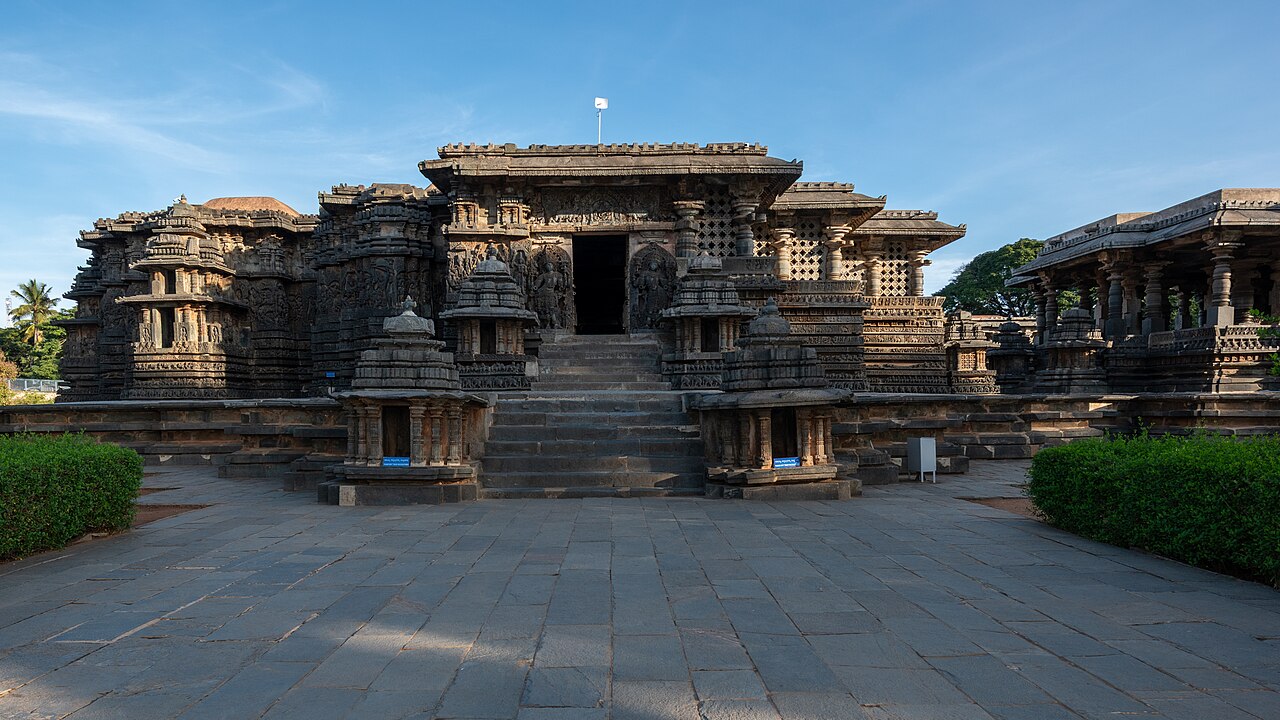
The property covers the Chennakeshava temple at Belur, the Hoysaleswara temple at Halebidu, and the Keshava temple at Somanathapura. All three are Hoysala-period temples, and all three are extraordinary for the density and precision of their carving.
History
The Hoysalas ruled much of what is now Karnataka between the eleventh and fourteenth centuries. Chennakeshava at Belur was begun around 1117 under Vishnuvardhana; Hoysaleswara at Halebidu followed later in the twelfth century; Keshava at Somanathapura was completed in 1268. Halebidu was sacked in the fourteenth century and its towers were never rebuilt.
Architecture
The temples are built on stellate — star-shaped — plans raised on a jagati platform, which multiplies the wall surface available for carving. The stone is chloritic schist, soft when quarried and hardening on exposure, which allows undercutting fine enough to produce free-standing detail: jewellery with separate strands, bracelet beads that move. Wall friezes run in continuous horizontal bands of elephants, horsemen, foliage and narrative scenes from the epics. Unusually, many carvings are signed by their sculptors.
Significance
Hoysala temples represent a distinct regional idiom, neither northern nor purely southern, taken to a technical extreme. The signatures are also notable: they name individual craftsmen at a period when that was rare anywhere.
UNESCO recognition
Inscribed in 2023 under criteria (i) and (ii) as a masterpiece of creative genius and for the exchange of architectural developments.
More views
4 images