Khangchendzonga National Park
Sikkim
- Inscribed
- 2016
- Period
- National park from 1977
- Property
- Mixed
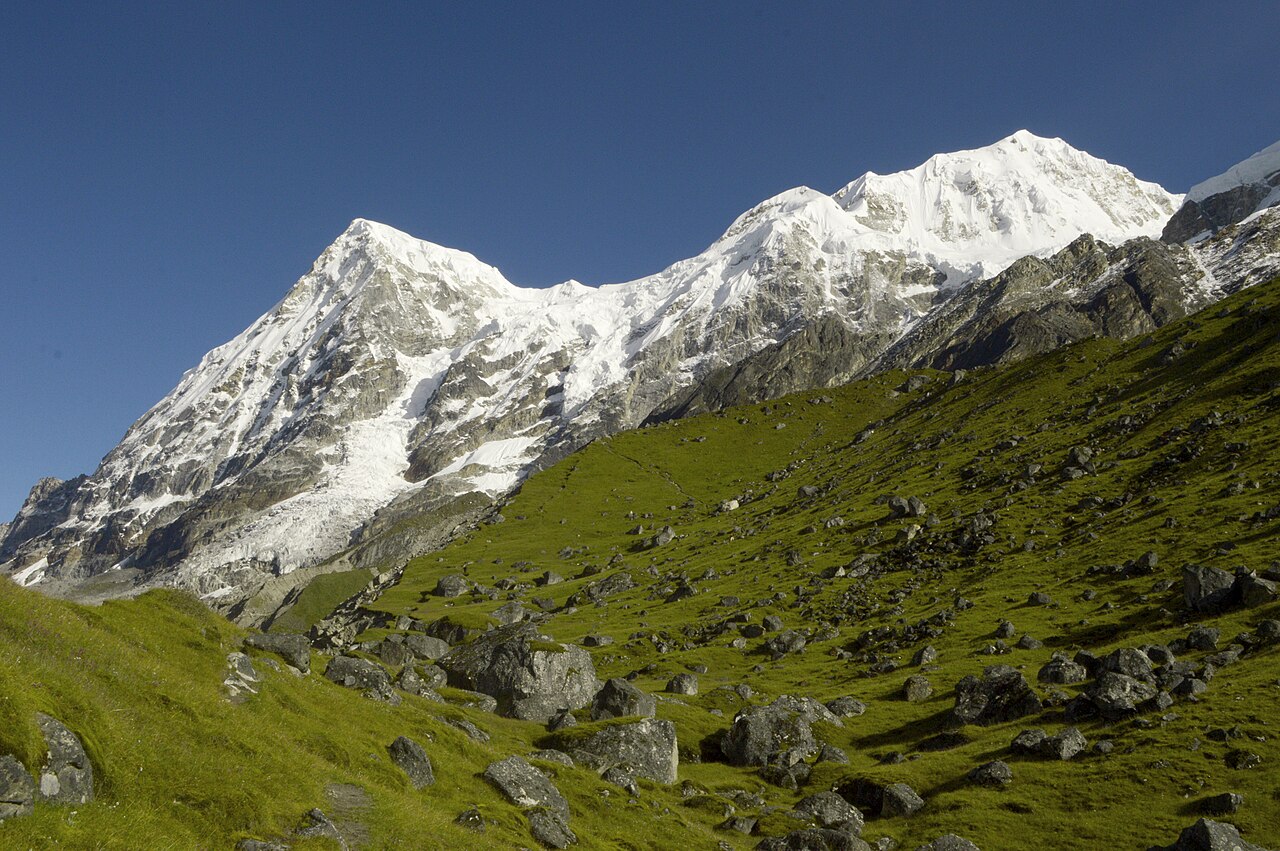
The park covers a large part of northern and western Sikkim, centred on Khangchendzonga, the third-highest mountain in the world. It was inscribed under both natural and cultural criteria — the only Indian property in that category.
History
The park was established in 1977 and expanded subsequently. Khangchendzonga is regarded as sacred in Sikkimese Buddhist and Lepcha tradition, understood as a protective deity, and this is reflected in local practice: Sikkim's summit is by convention left untrodden, and climbers stop short of the true top. The property was inscribed in 2016.
Landscape and wildlife
Altitude runs from about 1,200 metres to 8,586 at the summit, giving subtropical forest, temperate broadleaf and conifer forest, alpine meadow and extensive glaciers within one property. The Zemu glacier is among the largest in the eastern Himalaya. Wildlife includes snow leopard, Himalayan black bear, red panda, blue sheep and Himalayan tahr.
Significance
Khangchendzonga is inscribed for the inseparability of its natural and cultural values: the mountain is both an exceptional ecological system and a sacred landscape whose meanings are still actively held. Indigenous belief here functions as a form of protection rather than as a heritage exhibit.
UNESCO recognition
Inscribed in 2016 under criteria (iii), (vi), (vii) and (x) — the only mixed property in India, recognised for both cultural association and natural significance.
More views
4 images