
Rani-ki-Vav, the Queen's Stepwell
Patan, Gujarat
- Inscribed
- 2014
- Period
- 11th century
- Property
- Cultural
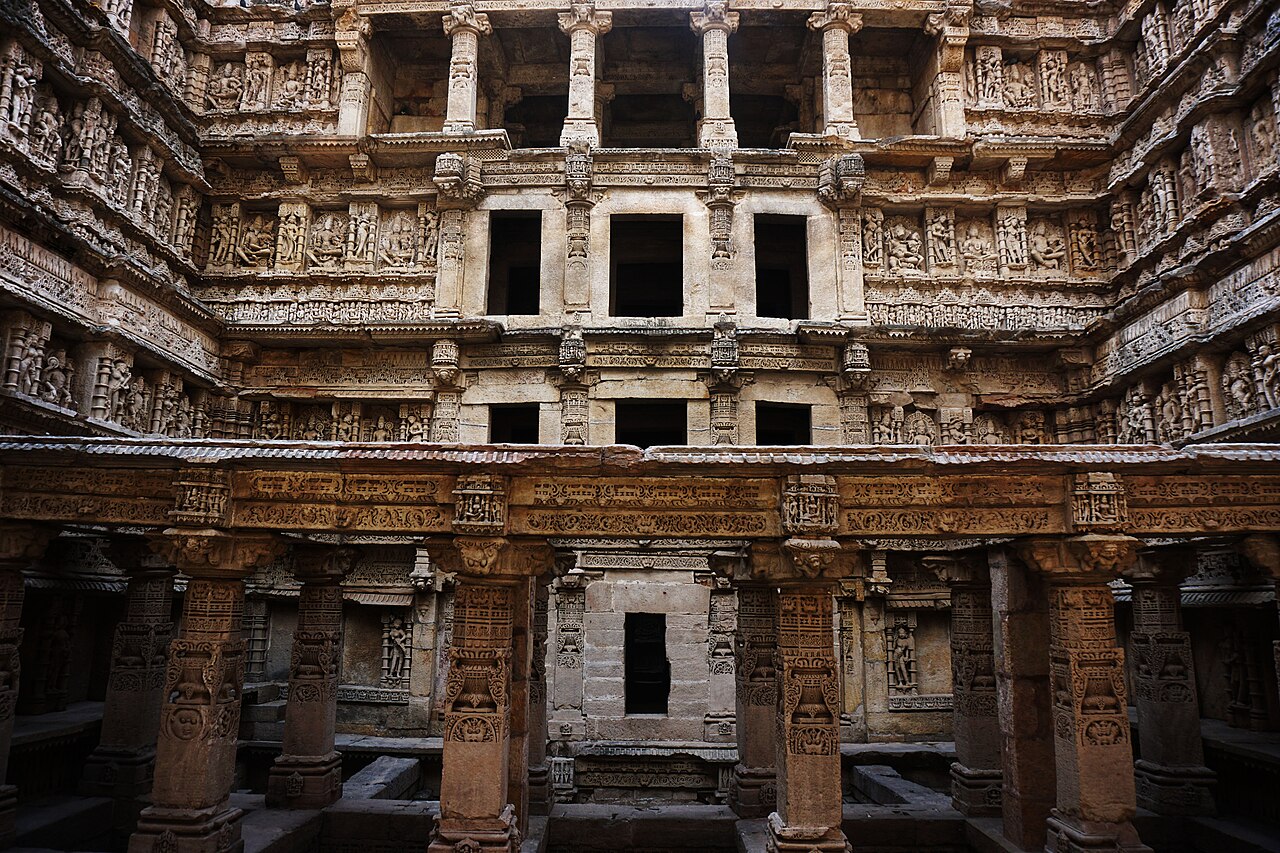
Rani-ki-Vav is a stepwell on the bank of the Saraswati river at Patan, built as a memorial and as a water source. It is organised as an inverted temple, descending in stages to the water table, with the shaft at the far end.
History
The stepwell is attributed to Queen Udayamati, in memory of her husband Bhima I of the Chaulukya dynasty, and dated to the eleventh century. The Saraswati flooded and the well silted up, burying it for centuries. It was excavated by the Archaeological Survey of India in the 1980s, and the sculpture emerged in remarkable condition precisely because it had been packed in silt rather than exposed.
Architecture
The well descends through seven levels of stairs and galleries to a rectangular shaft. More than five hundred principal sculptures and over a thousand minor ones cover the walls, most on religious themes; Vishnu in his ten avatars is prominent, together with apsaras and nagakanyas. The design treats water as sacred and the descent as a ritual sequence rather than a utility.
Significance
Rani-ki-Vav is the high point of the stepwell as a building type, and demonstrates a subterranean water architecture developed for a region of scarce and seasonal rainfall. Its condition makes it the best surviving example of Maru-Gurjara sculpture at scale.
UNESCO recognition
Inscribed in 2014 under criteria (i) and (iv) as a masterpiece of craftsmanship and an outstanding example of subterranean water architecture.
More views
4 images