
Hill Forts of Rajasthan
Chittorgarh, Kumbhalgarh, Ranthambore, Amber, Jaisalmer and Gagron
- Inscribed
- 2013
- Period
- 8th–18th century
- Property
- Cultural
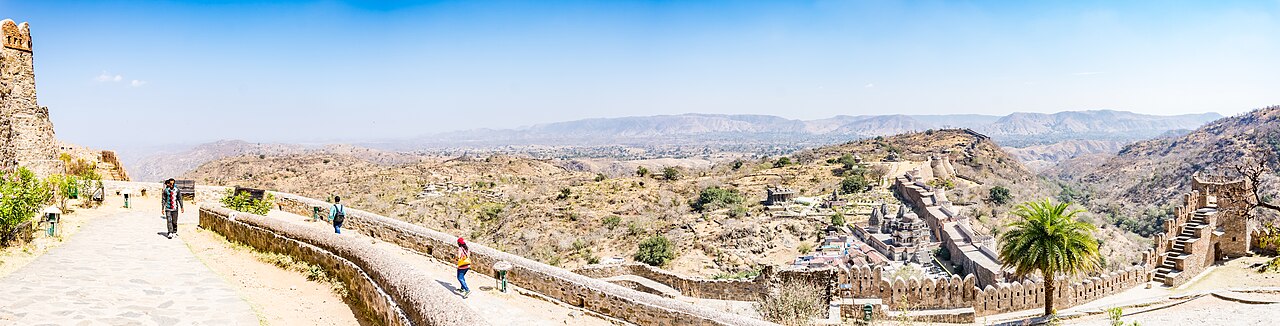
A serial property of six forts across Rajasthan: Chittorgarh, Kumbhalgarh, Sawai Madhopur (Ranthambore), Jhalawar (Gagron), Jaipur (Amber) and Jaisalmer. Each is an extensive fortified enclosure containing palaces, temples, water structures and urban quarters.
History
The forts were built and rebuilt between roughly the eighth and eighteenth centuries under various Rajput states. Chittorgarh, the largest, was besieged repeatedly and is associated with the jauhar of its defenders. Amber served the Kachhwahas before Jaipur was founded on the plain below. Jaisalmer is unusual in remaining continuously inhabited.
Architecture
The defining principle is the use of terrain: walls follow ridgelines and cliffs rather than imposing a geometric plan, so the hill does much of the defensive work. Kumbhalgarh's perimeter wall runs some thirty-six kilometres. Within the walls the forts contain palaces, Hindu and Jain temples, stepwells and tanks — water management being as strategically important as the walls. Jaisalmer is built in yellow sandstone that gives the whole fort a single colour.
Significance
Together the six show Rajput military architecture over a thousand years, and record a form of fortification that encloses a functioning settlement rather than a purely military post. Jaisalmer remains a living fort with residents inside the walls, which brings its own conservation problems.
UNESCO recognition
Inscribed in 2013 under criteria (ii) and (iii) for the interchange of Rajput architectural traditions and as testimony to Rajput culture.
More views
4 images