

The Jantar Mantar, Jaipur
Jaipur, Rajasthan
- Inscribed
- 2010
- Period
- 1727–1734
- Property
- Cultural
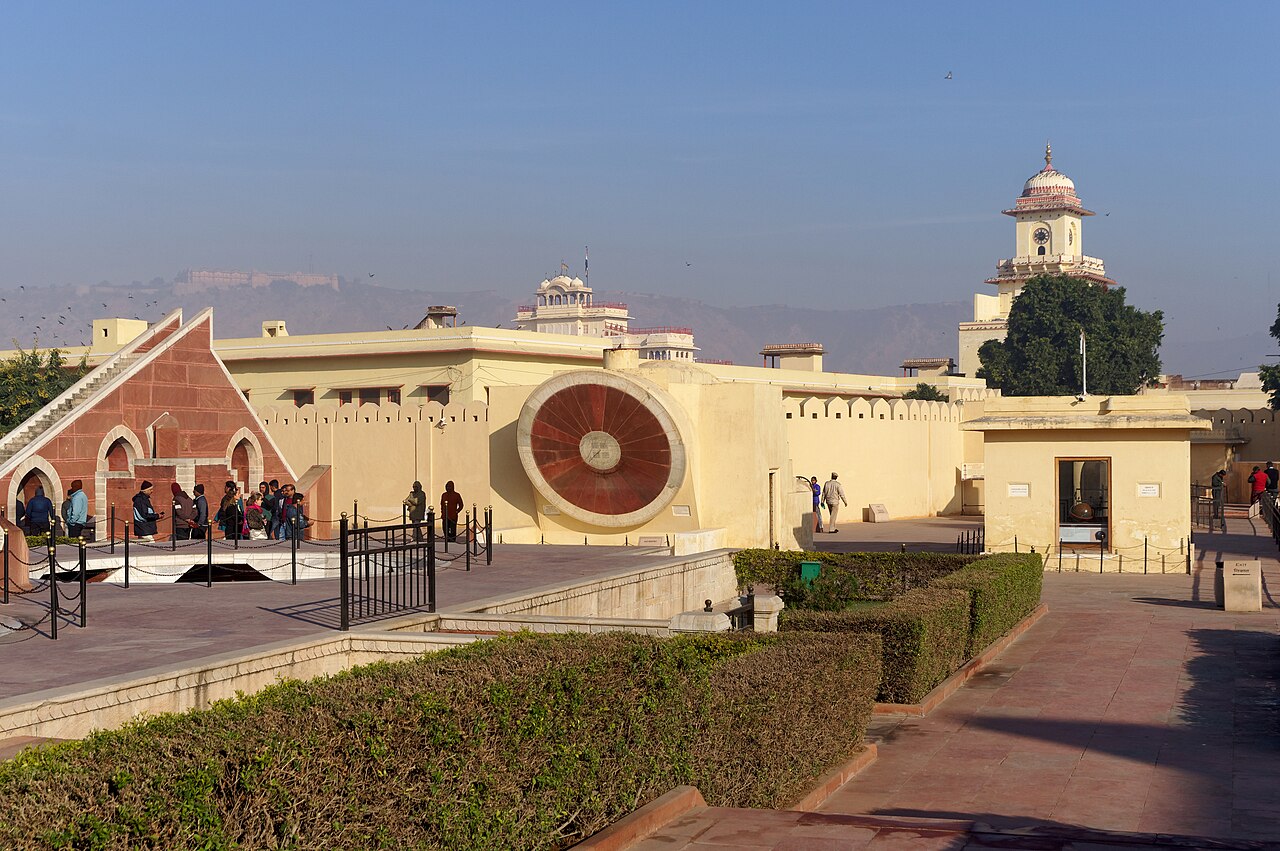
The Jantar Mantar is a collection of nineteen fixed astronomical instruments built in masonry and stone, designed for naked-eye observation. It is the largest and best preserved of five such observatories built by Sawai Jai Singh II.
History
Jai Singh II, ruler of Amber and founder of Jaipur, built observatories at Delhi, Jaipur, Ujjain, Mathura and Varanasi in the first half of the eighteenth century. The Jaipur instruments were constructed between 1727 and 1734. Jai Singh drew on Islamic, Hindu and European astronomical traditions, and had Ptolemaic and contemporary European work translated for the purpose.
Architecture
The instruments are architectural in scale, built because size increases precision when reading by eye. The Samrat Yantra, a right-triangle gnomon about twenty-seven metres high with quadrant scales on either side, is the largest stone sundial in the world. The Jai Prakash Yantra is a pair of hemispherical bowls sunk into the ground, marked so an observer can read a star's position directly. The Ram Yantra measures altitude and azimuth; twelve Rashivalaya instruments are each aligned to a zodiac sign.
Significance
The observatory is a monumental expression of the astronomical knowledge of its period, and a case of scientific instruments built at architectural scale. It remains in a condition where the instruments can still be read.
UNESCO recognition
Inscribed in 2010 under criteria (iii) and (iv) as testimony to the astronomical skills of its period and an outstanding example of a monumental observatory.
More views
4 images