Taj Mahal
Agra, Uttar Pradesh
- Inscribed
- 1983
- Period
- 17th century
- Property
- Cultural
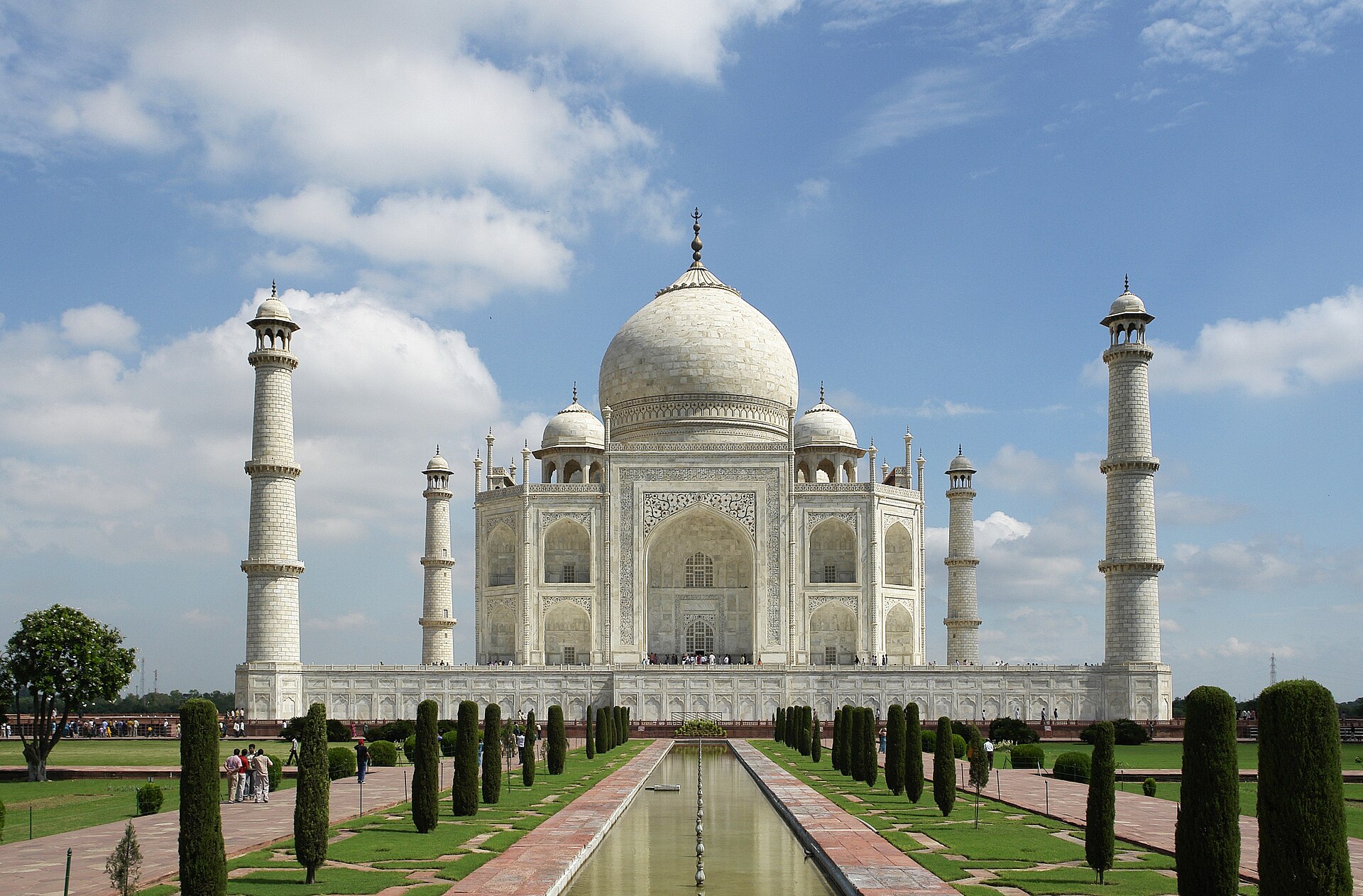
The Taj Mahal is an ivory-white marble mausoleum on the right bank of the river Yamuna in Agra. It was commissioned in 1631 by the Mughal emperor Shah Jahan to house the tomb of his favourite wife, Mumtaz Mahal. The tomb is the centrepiece of a 17-hectare complex that includes a mosque and a guest house, and is set in formal gardens bounded on three sides by a crenellated wall.
History
Mumtaz Mahal died in 1631 during the birth of their fourteenth child. Shah Jahan, consumed by grief, commissioned the Taj Mahal immediately. Construction began around 1632 and was largely complete by 1643, though work on the surrounding elements continued until 1553. An estimated 20,000 artisans and 1,000 elephants were employed. The primary architect is believed to be Ustad Ahmad Lahauri, though the design drew on traditions from Ottoman, Persian, and Indian architecture.
Architecture
The mausoleum stands on a square plinth and is topped by an iconic bulbous dome rising 35 metres. The exterior is clad in white marble inlaid with semi-precious stones (pietra dura) forming floral and geometric patterns. Four minarets at the corners of the plinth lean slightly outward. The interior houses the cenotaphs of Mumtaz Mahal and Shah Jahan in an octagonal chamber decorated with marble screens and calligraphic inscriptions from the Quran.
Significance
The Taj Mahal is widely regarded as the finest example of Mughal architecture and a symbol of India's cultural heritage. It attracts 7–8 million visitors annually and was named one of the New Seven Wonders of the World in 2007. The monument represents the pinnacle of Mughal artistic achievement and the enduring power of its founding love story.
UNESCO recognition
Inscribed under Criteria (i) as a masterpiece of creative genius, and (iii) as an outstanding example of Mughal architecture that illustrates a significant stage in human history.
More views
7 images