Indus Valley
- Period
- c. 2600–1900 BCE
- Era
- 01 / 8
Grid-planned cities at Mohenjo-daro and Dholavira, with covered drains, standardised brick, and a script still unread.
About
The subcontinent's first urban civilisation, spread across the Indus basin and well beyond it into what is now Gujarat, Rajasthan and Haryana. Its cities were laid out on a grid, built from bricks made to a standard ratio, and served by covered drains and wells at a density not matched again in the region for millennia. Almost everything known about it comes from excavation, because its writing cannot be read.
Context
Settlement in the region begins far earlier, at sites such as Mehrgarh, and the mature urban phase runs roughly from 2600 to 1900 BCE. Major sites include Mohenjo-daro and Harappa in present-day Pakistan, and Dholavira, Lothal, Rakhigarhi and Kalibangan in India. Trade connected the region to Mesopotamia; Indus seals have been found at Mesopotamian sites. The civilisation was unknown to modern scholarship until excavations in the 1920s, when Daya Ram Sahni worked at Harappa and R. D. Banerji at Mohenjo-daro — before which the period was simply absent from the record.
What survives
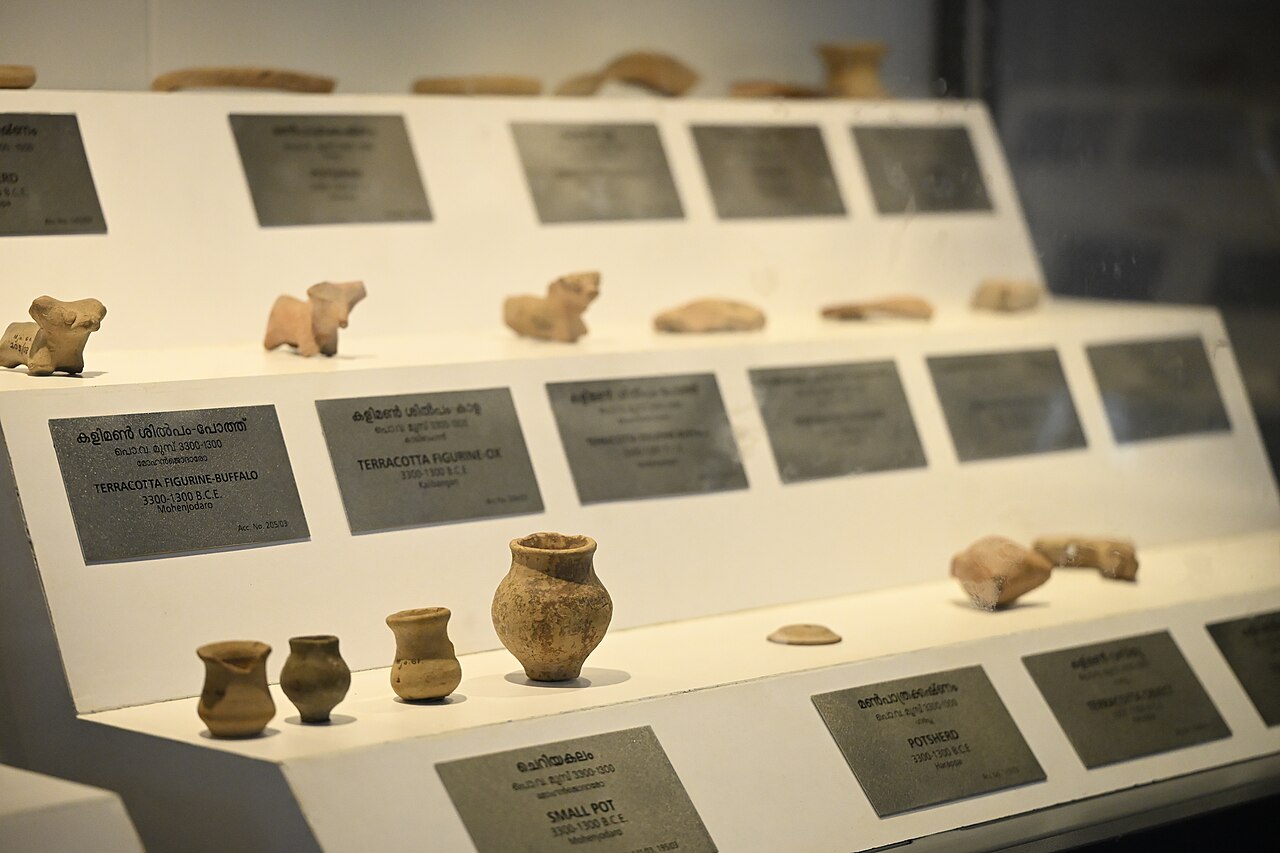
Street plans, drainage systems, wells, granaries, dockyards and reservoirs; standardised baked brick in a consistent proportion; a system of weights of remarkable uniformity; thousands of carved seals; terracotta figurines; and the bronze figure conventionally called the Dancing Girl. What does not survive is any readable text. The script runs to several hundred signs, appears mostly in very short inscriptions, and remains undeciphered — which is why there are no names, no rulers and no events for this period, only material.
Significance
This is the period that sets the terms for everything after it: settled agriculture, urban planning, standardised measurement and long-distance trade. It is also the clearest reminder of how much of the past is unrecoverable. A civilisation of this scale left cities that can be walked through and a language that cannot be read.
Material from this period
3 images