
Rock Shelters of Bhimbetka
Raisen district, Madhya Pradesh
- Inscribed
- 2003
- Period
- Mesolithic onward
- Property
- Cultural
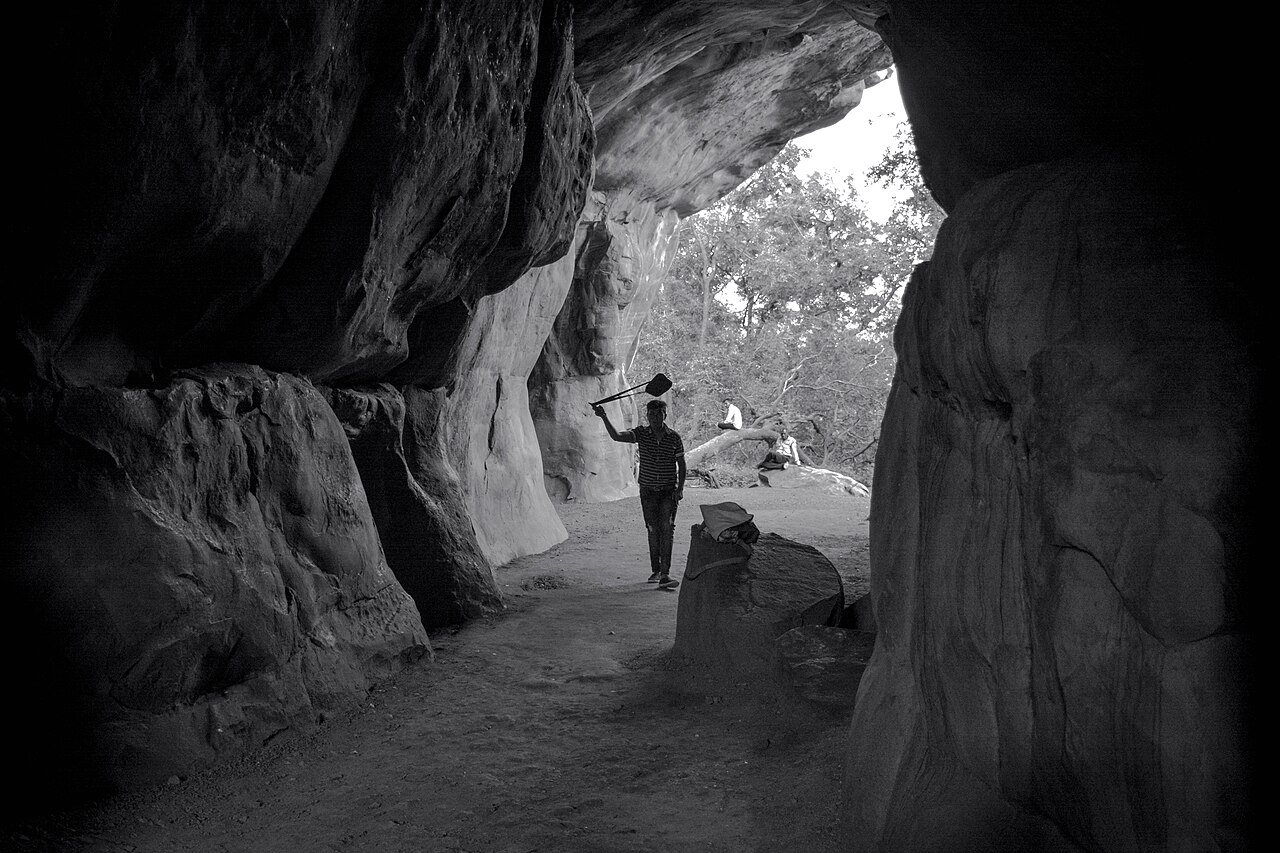
Bhimbetka is a dense group of natural rock shelters in the Vindhyan hills, about forty-five kilometres south of Bhopal. Several hundred shelters carry paintings, of which a subset is open to visitors. The site records human occupation over an exceptionally long span.
History
The shelters were identified as significant by V. S. Wakankar in 1957. Excavation has produced stone tools from the Acheulean onward, and the painted sequence is generally taken to begin in the Mesolithic and continue, in layers, into the historic period. Some walls carry images from several widely separated periods superimposed.
Architecture
The paintings are in natural pigments, predominantly red and white, with some green and yellow. Subjects include hunting scenes, animals — bison, tigers, rhinoceros, elephants — dancers, and later horses and riders with weapons that place those images much closer to the present. The shelters themselves are formed by weathering of the quartzitic sandstone.
Significance
Bhimbetka holds some of the earliest known traces of human life on the subcontinent, and the paintings give an unusually direct view of how people lived. UNESCO's citation notes the continuity between what is painted on the rock and the practices of the villages immediately below the hill.
UNESCO recognition
Inscribed in 2003 under criteria (iii) and (v) as testimony to a long cultural tradition and as an outstanding example of a human settlement in interaction with its environment.
More views
4 images