Chhatrapati Shivaji Maharaj Terminus
Mumbai, Maharashtra
- Inscribed
- 2004
- Period
- 1878–1888
- Property
- Cultural
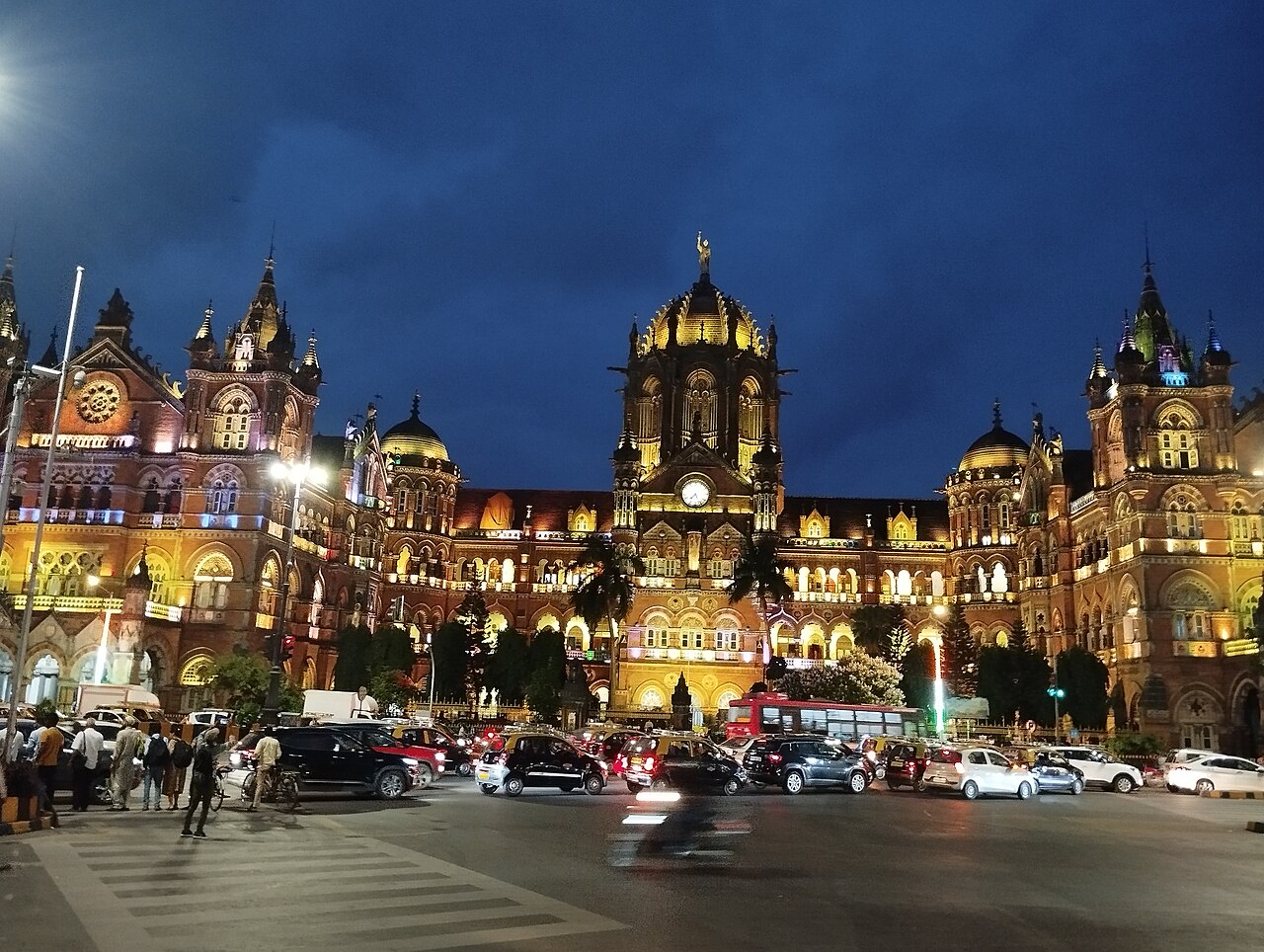
Formerly Victoria Terminus, the station is the headquarters of Central Railway and one of the busiest railway stations in India. It is a working terminus, not a museum, and the building carries the load of an ordinary weekday alongside its heritage status.
History
Designed by Frederick William Stevens, construction ran from 1878 to 1888 and the building was named for Queen Victoria in her jubilee year. It was renamed Chhatrapati Shivaji Terminus in 1996 and Chhatrapati Shivaji Maharaj Terminus in 2017. The building was among the sites attacked in November 2008.
Architecture
The design is High Victorian Gothic Revival — pointed arches, a ribbed dome, gargoyles and a skyline of turrets — executed in local yellow Kurla stone with Italian marble and blue-grey granite detail. The ornament was carved by students of the Sir Jamsetjee Jeejebhoy School of Art, and the vocabulary is Indian: peacocks, monkeys, elephants and local floral forms worked into Gothic framing. A statue representing Progress crowns the dome.
Significance
CSMT is the fullest expression of the hybrid style that developed in nineteenth-century Bombay, where a European structural idiom was executed by Indian craftsmen using Indian motifs. UNESCO describes it as an outstanding example of that meeting.
UNESCO recognition
Inscribed in 2004 under criteria (ii) and (iv) for the interchange of Victorian Gothic and Indian traditions and as an outstanding example of that fusion.
More views
4 images