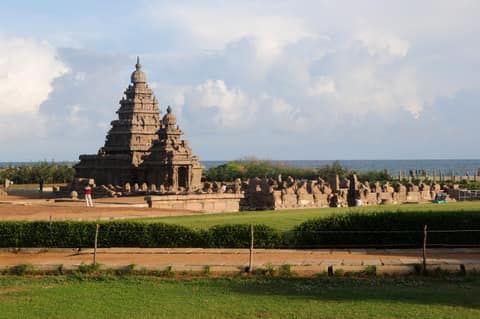
Mahabodhi Temple Complex
Bodh Gaya, Bihar
- Inscribed
- 2002
- Period
- 3rd century BCE onward; present temple 5th–6th century CE
- Property
- Cultural
The Mahabodhi Temple Complex marks the site of the Buddha's enlightenment. It contains the main temple, the Bodhi tree, the Vajrasana or diamond throne, and a series of six sacred places associated with the weeks the Buddha is said to have spent there after enlightenment, together with votive stupas.
History
Ashoka is credited with the first shrine at the site in the third century BCE, and the polished sandstone Vajrasana is attributed to him. The present temple is generally dated to the fifth or sixth century CE, with substantial later restoration, including major nineteenth-century work under Alexander Cunningham and Joseph Beglar. The tree now standing is held to descend from the original.
Architecture
The temple is built of brick — unusual for a surviving structure of this age in India — and rises about fifty metres in a straight-sided pyramidal tower with a series of stepped niches and small corner towers repeating the form. A stone railing, parts of which are earlier than the temple, surrounds the complex; sections are original and sections are later replacement.
Significance
Bodh Gaya is the most important of the four principal Buddhist pilgrimage sites, and the temple is one of the earliest brick structures still standing in the subcontinent. Its form influenced Buddhist architecture across Asia, and reproductions of it were built as far away as Myanmar and Thailand.
UNESCO recognition
Inscribed in 2002 under criteria (i), (ii), (iii), (iv) and (vi), covering its architectural achievement, its influence, and its direct association with the life of the Buddha.
More views
4 images