Fatehpur Sikri
Agra district, Uttar Pradesh
- Inscribed
- 1986
- Period
- 1571–1585
- Property
- Cultural
Fatehpur Sikri is a walled city about forty kilometres west of Agra, built by Akbar as his capital and occupied only briefly. Its palaces, courts, mosque and administrative buildings survive largely as constructed, because almost nothing was built over them afterwards.
History
Akbar founded the city in 1571, traditionally in fulfilment of a vow after the Sufi saint Salim Chishti foretold the birth of an heir. The court moved there and the principal buildings went up quickly in local red sandstone. It was effectively abandoned by about 1585, with water supply usually given as the reason, and the capital moved to Lahore and later back to Agra.
Architecture
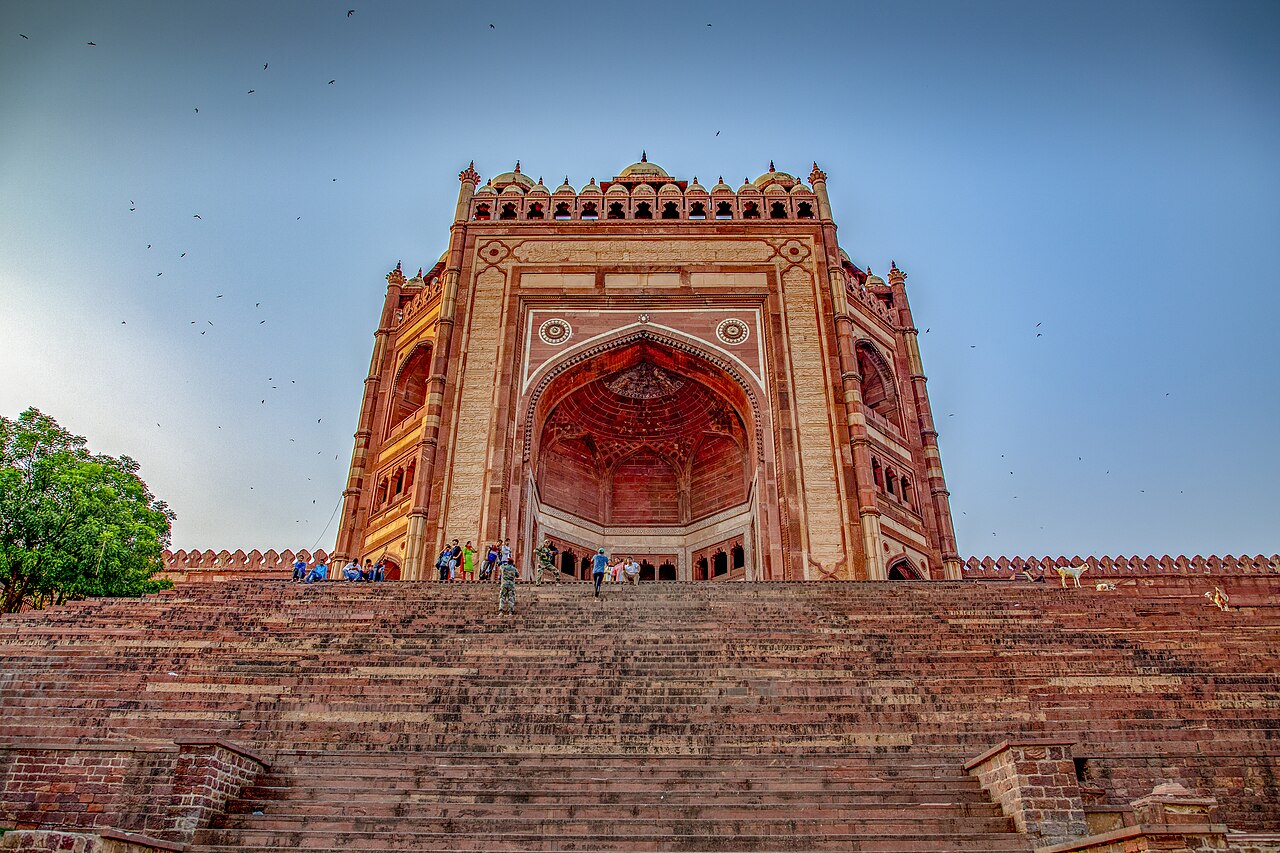
The buildings are trabeated — post and beam, cut in sandstone — rather than arched, drawing on Gujarati and Rajasthani craft traditions as much as Persian ones. The Diwan-i-Khas has a single central pillar with a carved capital supporting radiating bridges. The Buland Darwaza, added around 1576, is a gateway some fifty-four metres high. Salim Chishti's tomb, in white marble with pierced screens, sits within the mosque courtyard. The Panch Mahal is a five-storeyed open pavilion of diminishing tiers.
Significance
Fatehpur Sikri is the most complete surviving Mughal city plan, and the clearest statement of Akbar's synthesis: Hindu, Jain and Islamic forms and craft used together in one programme, at one moment, by one patron.
UNESCO recognition
Inscribed in 1986 under criteria (ii), (iii) and (iv) for its influence, its testimony to Mughal civilisation, and as an outstanding architectural ensemble.
More views
4 images