Jaipur City, Rajasthan
Jaipur, Rajasthan
- Inscribed
- 2019
- Period
- Founded 1727
- Property
- Cultural
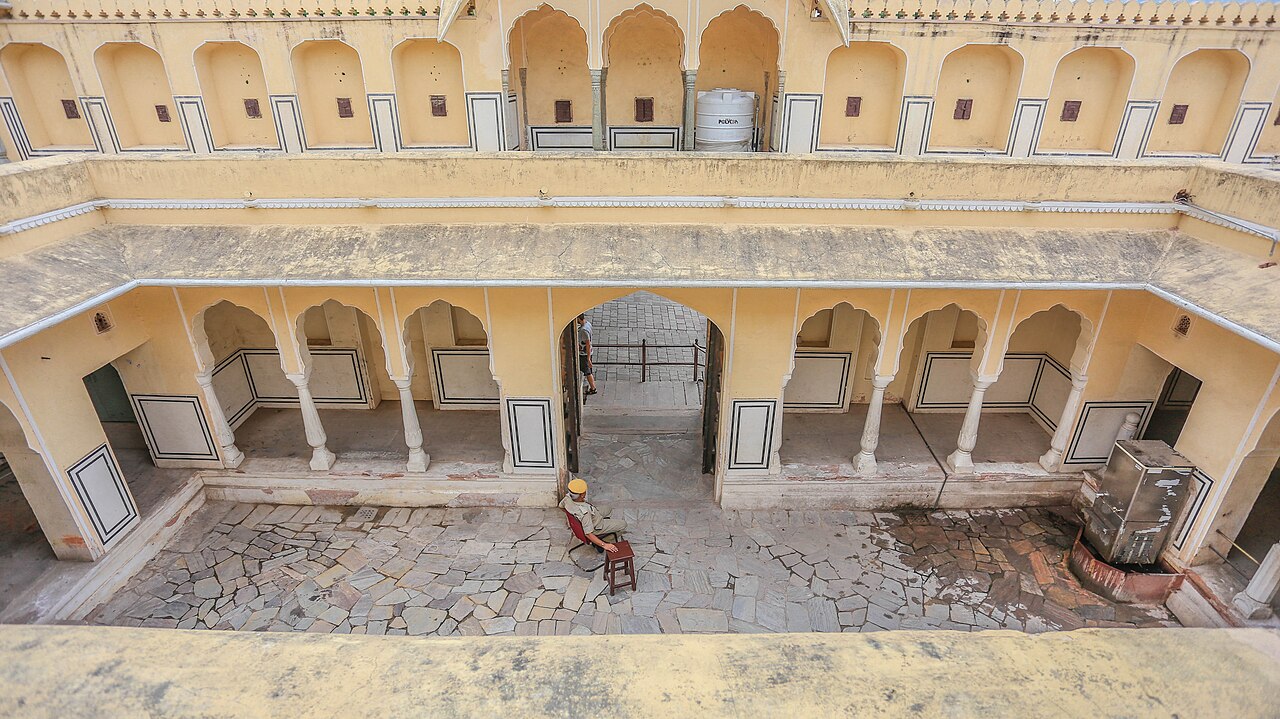
The inscribed property is the walled city of Jaipur, founded by Sawai Jai Singh II and laid out on a grid of wide streets with continuous colonnaded market frontages, gates, and a palace and observatory quarter at its centre.
History
Jai Singh II moved his capital down from the hill fort at Amber in 1727, choosing flat ground and a planned layout. Vidyadhar Bhattacharya is credited with the plan. The uniform pink wash that gives the city its nickname was applied in the nineteenth century, and has been maintained since.
Architecture
The plan is a grid of nine sectors with a chessboard logic drawn from Vastu principles, adapted to the terrain. Streets are unusually wide and lined with continuous arcaded shopfronts of consistent height, making commerce part of the urban design rather than an afterthought. Within the plan sit the City Palace, the Jantar Mantar observatory and the Hawa Mahal, whose five-storey screen of small windows allowed the women of the court to watch the street unseen.
Significance
Jaipur is an exceptional example of eighteenth-century urban planning, exchanging medieval defensive hill siting for a commercial grid on the plain. It shows Mughal, Rajput and Western planning ideas combined in a single deliberate scheme that is still legible and still inhabited.
UNESCO recognition
Inscribed in 2019 under criteria (ii), (iv) and (vi) for the interchange of planning ideas, as an outstanding example of urban planning, and for its living traditions.
More views
4 images