

Keoladeo National Park
Bharatpur, Rajasthan
- Inscribed
- 1985
- Period
- Created 18th century as a duck reserve
- Property
- Natural
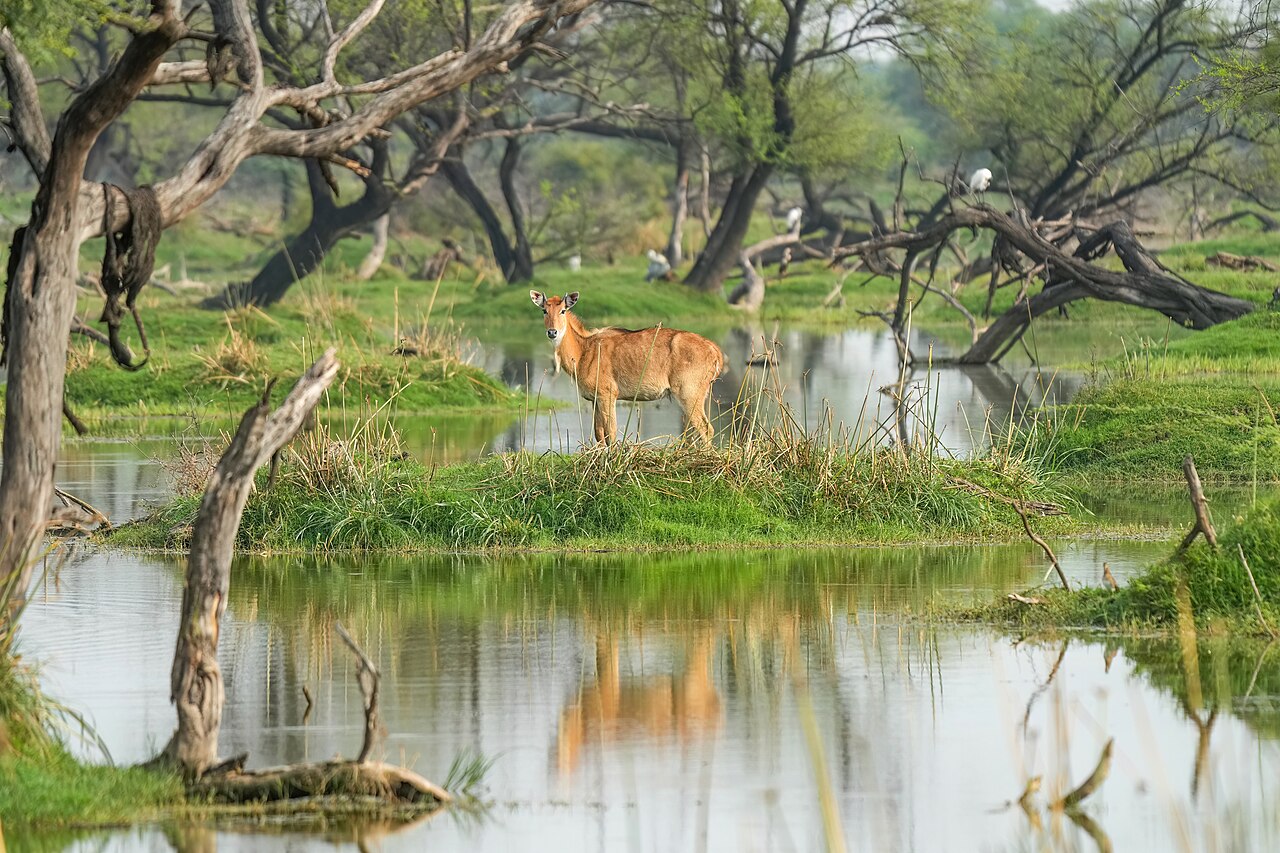
Keoladeo is a mosaic of shallow freshwater marsh, grassland, woodland and swamp covering about twenty-nine square kilometres on the edge of Bharatpur. It is entirely man-made in origin and entirely dependent on managed water.
History
The wetland was created in the eighteenth century by the Maharaja of Bharatpur, who dammed and flooded a natural depression to make a duck reserve. Shoots continued into the twentieth century with very large recorded bags. It became a bird sanctuary in 1956, a national park in 1982, and was inscribed in 1985. Grazing was banned in 1982, a decision that proved ecologically contentious.
Landscape and wildlife
Water is supplied from the Ajan Bund and has to be actively managed; in dry years the marsh can fail, and water allocation is a recurring conflict with agriculture. The park records well over three hundred bird species. It was formerly the only known wintering site in India for the western population of the Siberian crane, which has not been recorded here since 2002 and is presumed lost from this flyway.
Significance
Keoladeo demonstrates that a wholly artificial habitat can become internationally critical, and it is a case study in the difficulty of managing one: its ecology now depends on decisions about water release and grazing rather than on leaving it alone.
UNESCO recognition
Inscribed in 1985 under criterion (x) for the significance of its habitat for the conservation of biological diversity, particularly waterbirds.
More views
4 images