



Qutb Minar and its Monuments
Delhi
- Inscribed
- 1993
- Period
- 1199 onward
- Property
- Cultural
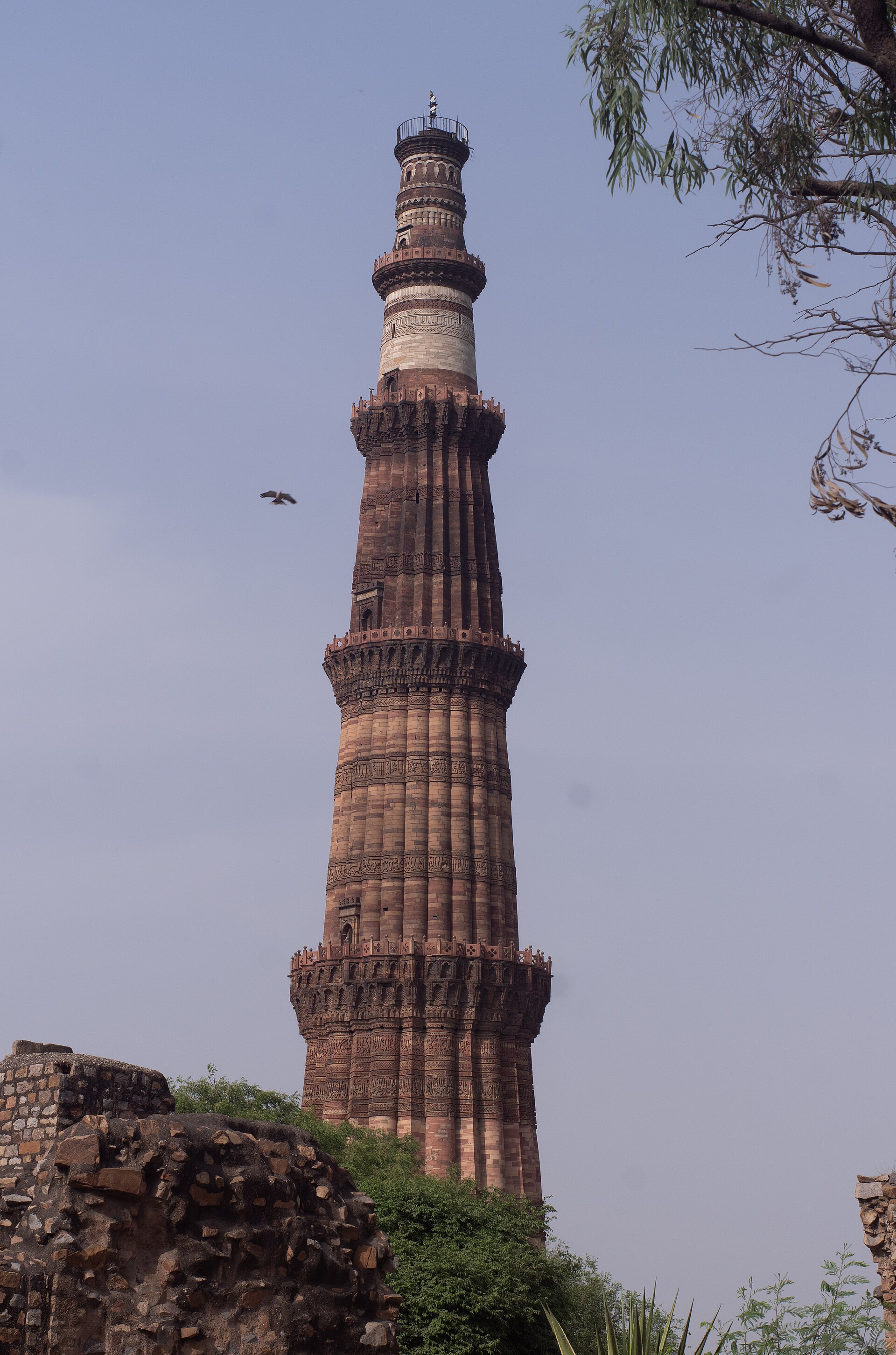
The Qutb Minar is a 73-metre tall tapering minaret built in the early 13th century. It stands within the Quwwat-ul-Islam Mosque complex, the first mosque built in India after the Islamic conquest. The complex also includes the mysterious Iron Pillar of Delhi, a 4th-century metallurgical marvel that has resisted corrosion for over 1,600 years.
History
Construction of the Qutb Minar was begun by Qutb ud-Din Aibak in 1199 and completed by his successor Iltutmish around 1220. Three more storeys were added by Firoz Shah Tughlaq in 1368 after an earthquake damaged the top. The Iron Pillar, originally erected in the 4th century CE inUdayagiri (Madhya Pradesh), was brought to Delhi by the Tomara rulers. The complex also contains the Alai Darwaza (1311) and the Alai Minar (unfinished, started by Alauddin Khalji in 1316).
Architecture
The Qutb Minar has five storeys, each marked by a projecting balcony supported on ornate muqarnas (stalactite) brackets. The first three storeys are of red sandstone, the fourth and fifth of marble and sandstone. Fluted and circular sections alternate, with each storey tapering progressively. The Quwwat-ul-Islam Mosque was built using materials from 27 demolished Hindu and Jain temples, and its pillars retain the original carved motifs.
Significance
The Qutb complex is a remarkable document of early Indo-Islamic architecture — a synthesis of Persian, Central Asian, and Indian building traditions. The Iron Pillar is a testament to ancient Indian metallurgy: its corrosion resistance is attributed to a protective layer of misawite (iron hydrogen phosphate hydrate) formed by the phosphorus content of the iron.
UNESCO recognition
Inscribed under Criteria (iv) as an outstanding example of early Indo-Islamic architecture, representing the beginning of a new architectural tradition in India.
More views
5 images