Buddhist Monuments at Sanchi
Raisen, Madhya Pradesh
- Inscribed
- 1989
- Period
- 3rd century BCE onward
- Property
- Cultural
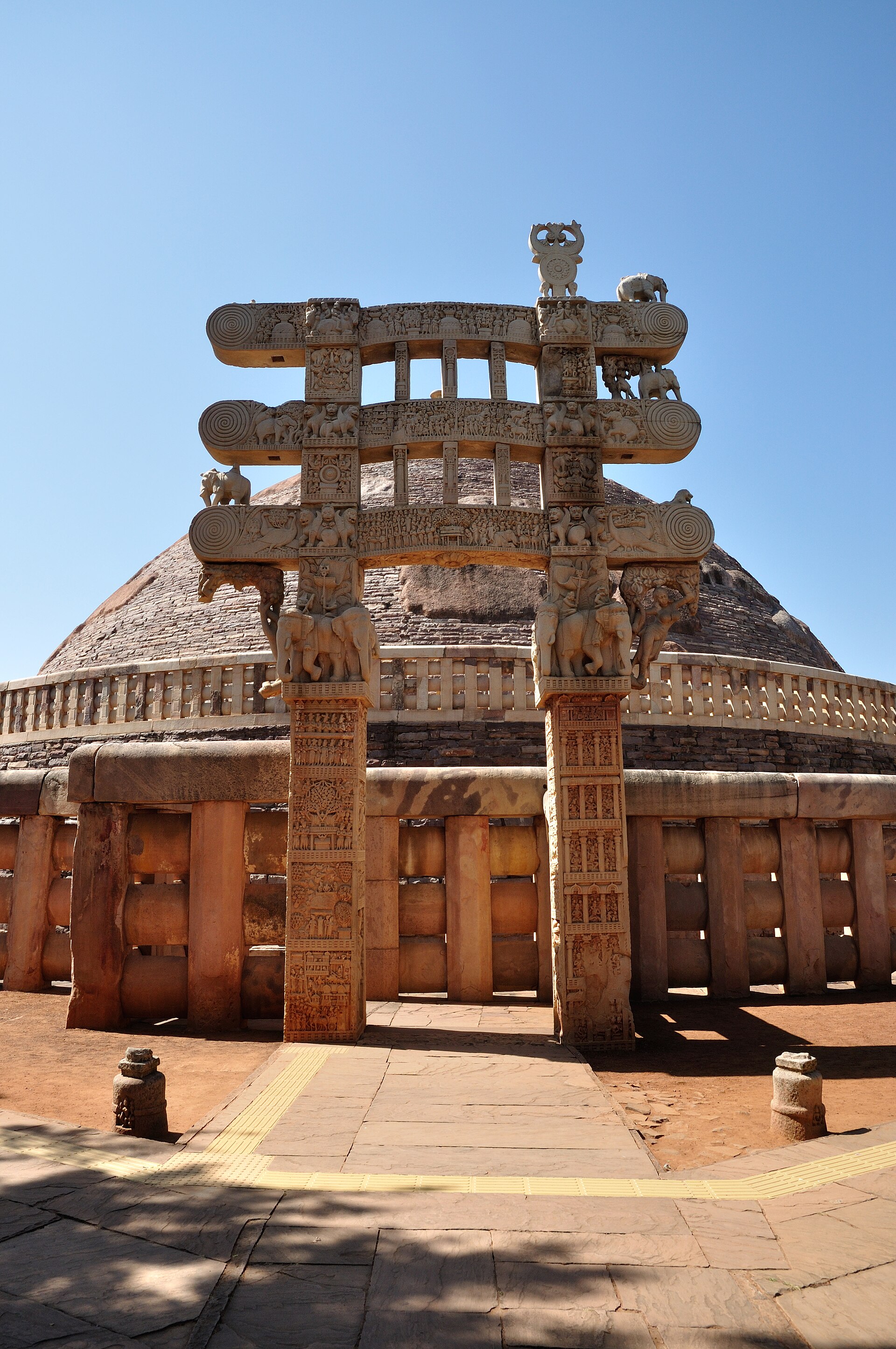
The Buddhist Monuments at Sanchi are among the oldest stone structures in India. The complex centres on the Great Stupa (Stupa 1), which was originally commissioned by Emperor Ashoka in the 3rd century BCE and enlarged in the 1st century BCE. The site includes stupas, temples, monasteries, and monolithic pillars.
History
Ashoka established the original brick stupa at Sanchi around 262 BCE to enshrine relics of the Buddha. In the 1st century BCE, the stupa was enlarged and encased in stone, and its four elaborately carved gateways (toranas) were added. The site was abandoned after the 12th century and was rediscovered in 1818 by General Henry Taylor. A major restoration was carried out in the early 20th century by Sir John Marshall.
Architecture
The Great Stupa is a hemispherical dome 16.46 metres high and 36.6 metres in diameter, surrounded by a stone balustrade and entered through four cardinal gateways. The gateways are covered with narrative relief sculptures depicting the Buddha's life, the Jataka tales, and scenes from Buddhist mythology. Notably, the Buddha is never shown in human form — instead, he is represented by symbols: a Bodhi tree, an empty throne, footprints, or a wheel.
Significance
Sanchi is the best-preserved group of Buddhist monuments in India and provides an unbroken record of Buddhist art and architecture from the 3rd century BCE to the 12th century CE. The gateways are masterpieces of narrative sculpture and were influential across Buddhist Asia. The Ashoka Pillar at Sanchi, with its four lions, inspired the State Emblem of India.
UNESCO recognition
Inscribed under Criteria (i), (ii), (iii), (iv), and (vi) — an exceptional testimony to Buddhist religious art and architecture, with outstanding influence across Asia.
More views
5 images