Ancient Buddhist Site of Sarnath
Varanasi, Uttar Pradesh
- Inscribed
- 2026
- Period
- 3rd century BCE onward
- Property
- Cultural
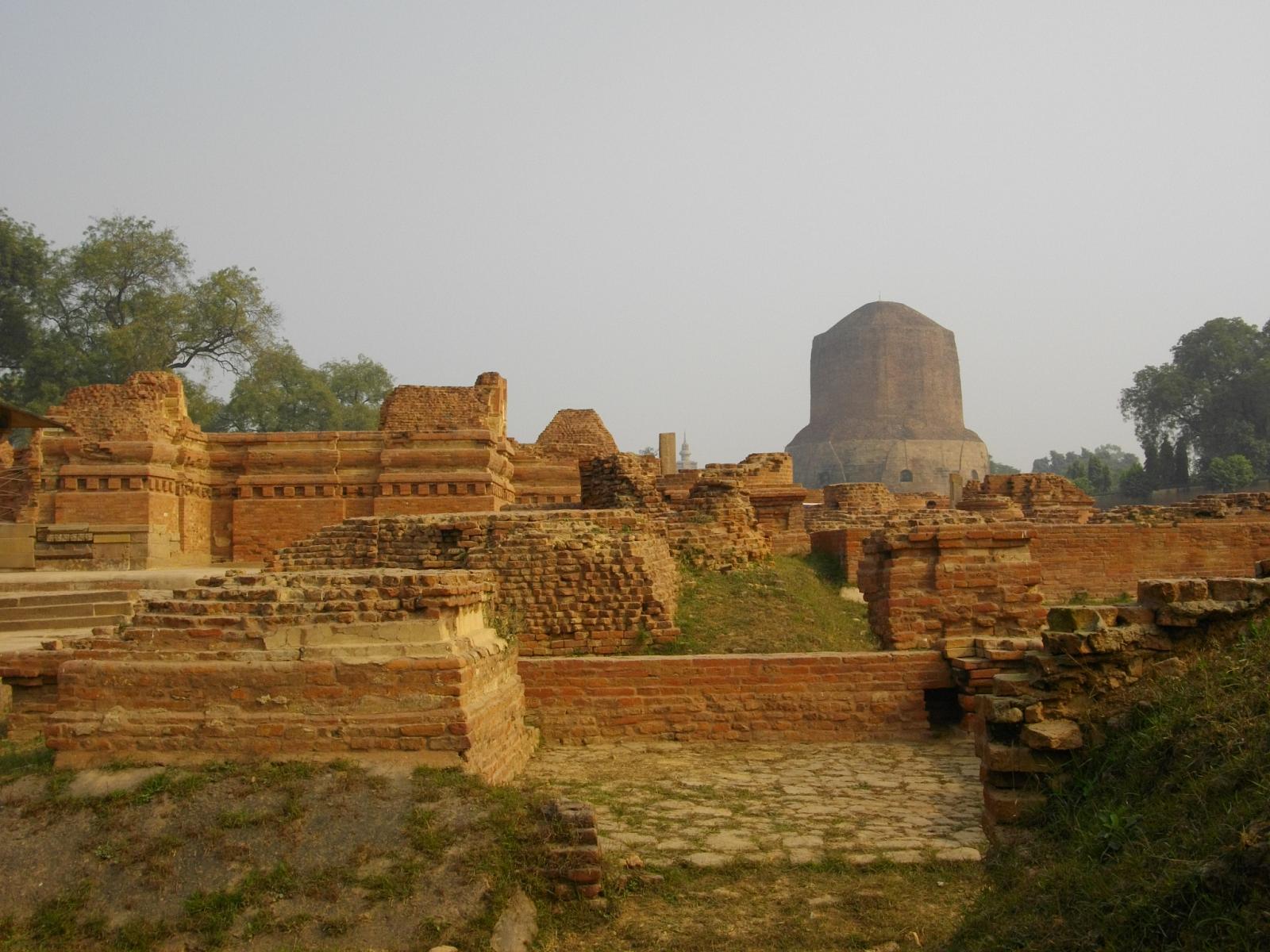
Sarnath is where the Buddha gave his first sermon after attaining enlightenment, making it one of the four holiest Buddhist pilgrimage sites. The Dhamek Stupa, built by Emperor Ashoka, marks the spot of the first sermon. The site also yielded the Lion Capital, now India's national emblem.
History
After attaining enlightenment at Bodh Gaya, the Buddha travelled to Sarnath and delivered his first discourse — the Dhammacakkappavattana Sutta — to five ascetics. Emperor Ashoka visited Sarnath around 249 BCE and erected a monastery, a pillar, and the Lion Capital. The site flourished until the 12th century, when it was destroyed by Turkic invasions. Systematic excavations began in the 19th century.
Architecture
The most prominent structure is the Dhamek Stupa, a massive cylindrical tower 43.6 metres high and 28 metres in diameter, built in stages from the 5th to 12th centuries. The Ashoka Pillar, fragments of which survive, was originally topped by the famous Lion Capital — four Asiatic lions standing back to back on an abacus adorned with a wheel, a bull, a horse, and an elephant. The monastic ruins reveal the layout of Buddhist monastic life.
Significance
Sarnath is the birthplace of the Buddhist Sangha (monastic community) and the site where the Dharma wheel was first set in motion. The Lion Capital of Ashoka, discovered here in 1904, was adopted as the State Emblem of India in 1950, and the Ashoka Chakra (wheel) from its abacus appears at the centre of the Indian national flag. Sarnath is India's 45th World Heritage property.
UNESCO recognition
Inscribed under Criteria (iii) as an outstanding testimony to the Buddhist tradition, and (vi) for its direct association with the life of the Buddha and the founding of the Sangha.
More views
5 images