Kathak
Temple storytelling; court form from the 16th century onward
- State
- Uttar Pradesh
- Of eight
- 02 / 8
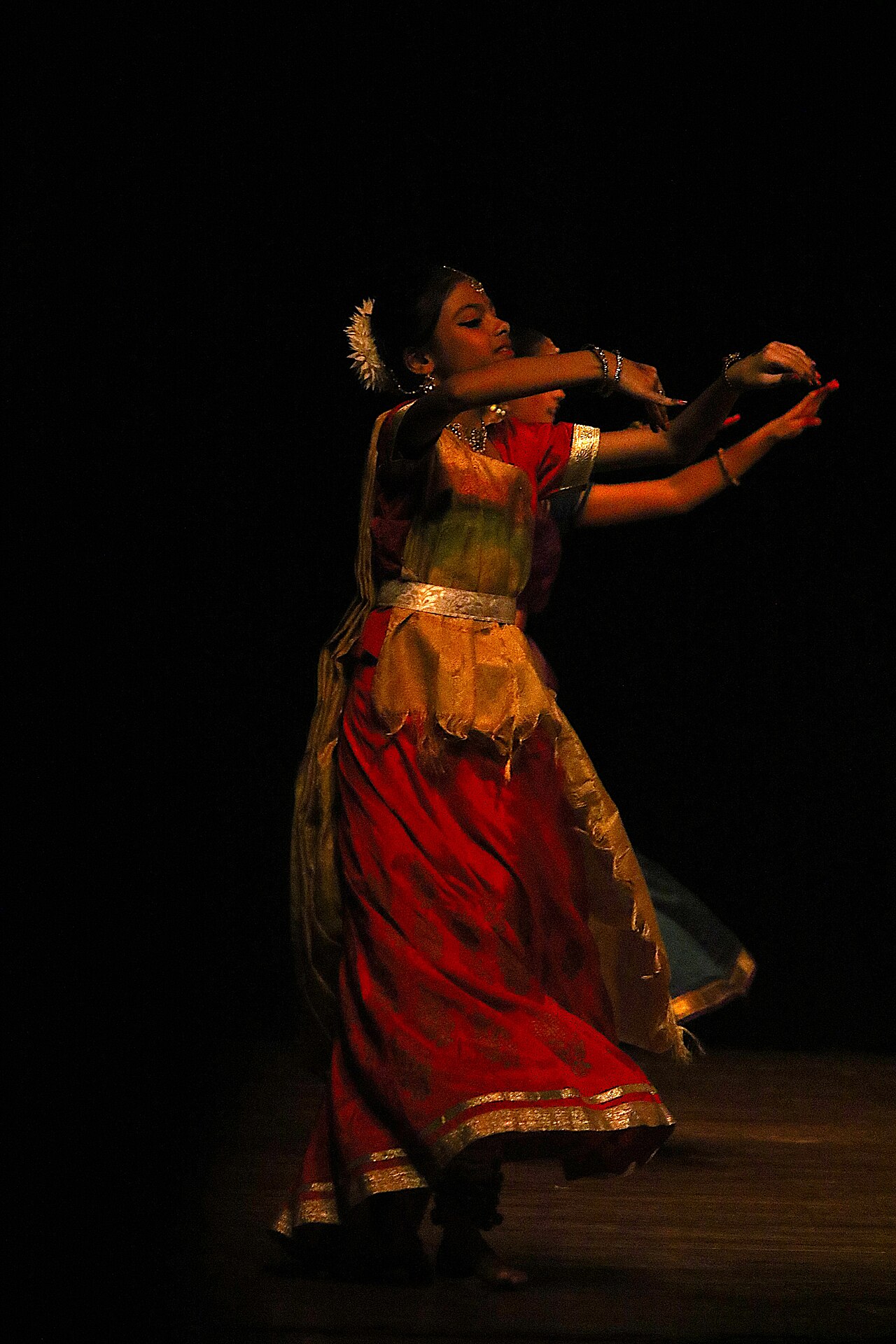
Storytellers' form carried from temple courtyard into Mughal court, where it took its spin and its footwork.
About
The only classical form of northern India, and the only one danced from an upright, unbent stance. Kathak is built on two things: rhythm worked out in the feet against a drummer, and narrative delivered in gesture and expression. Its signature is the chakkar, a fast turn on a fixed spot, repeated in multiples that resolve exactly on the beat.
History
The name comes from kathakar, a storyteller who recited epic material in temple courtyards. From the sixteenth century the form was taken up in the courts of northern India, and under Mughal and later Awadh patronage it absorbed Persian dress, a secular repertoire and an emphasis on virtuosity. Three gharanas carry it: Lucknow, associated with Bindadin Maharaj and weighted toward expression; Jaipur, weighted toward rhythmic complexity and footwork; and Banaras. Under colonial rule the form was pushed to the margins along with the courts that kept it, and was rebuilt after 1947 through the same institutional route as the other classical forms.
Technique
The body stays upright, weight even, with none of the deep knee-bend of the southern forms. Rhythm is played out in tatkar, footwork sounded against strings of ankle bells — often a hundred or more per ankle — and structured in tihais, phrases stated three times so that the last syllable lands on the first beat of the cycle. Turns are taken on the ball of one foot with the spine held vertical.
Repertoire
A recital typically opens slow, with invocation and a gradual laying-out of the rhythmic cycle, then builds through composed pieces — thaat, aamad, tora, tukra, paran — toward faster passages of pure rhythm. Expressive items set thumri or bhajan texts, most often on Krishna, and are usually placed as contrast between rhythmic sections.
Music and text
Hindustani music. Tabla or pakhawaj holds the rhythmic cycle, with sarangi or harmonium accompanying the melody; the dancer and the drummer trade phrases directly. Sung texts are commonly in Braj Bhasha, Hindi or Urdu.
Significance
Kathak is where two traditions met without either replacing the other: a Hindu narrative form that spent three centuries in Muslim courts and came out carrying both. It is the clearest performing-arts evidence that the composite culture of northern India was not a slogan but a working practice.
In performance
3 images