Kathakali
17th century, from Ramanattam and Krishnanattam
- State
- Kerala
- Of eight
- 03 / 8
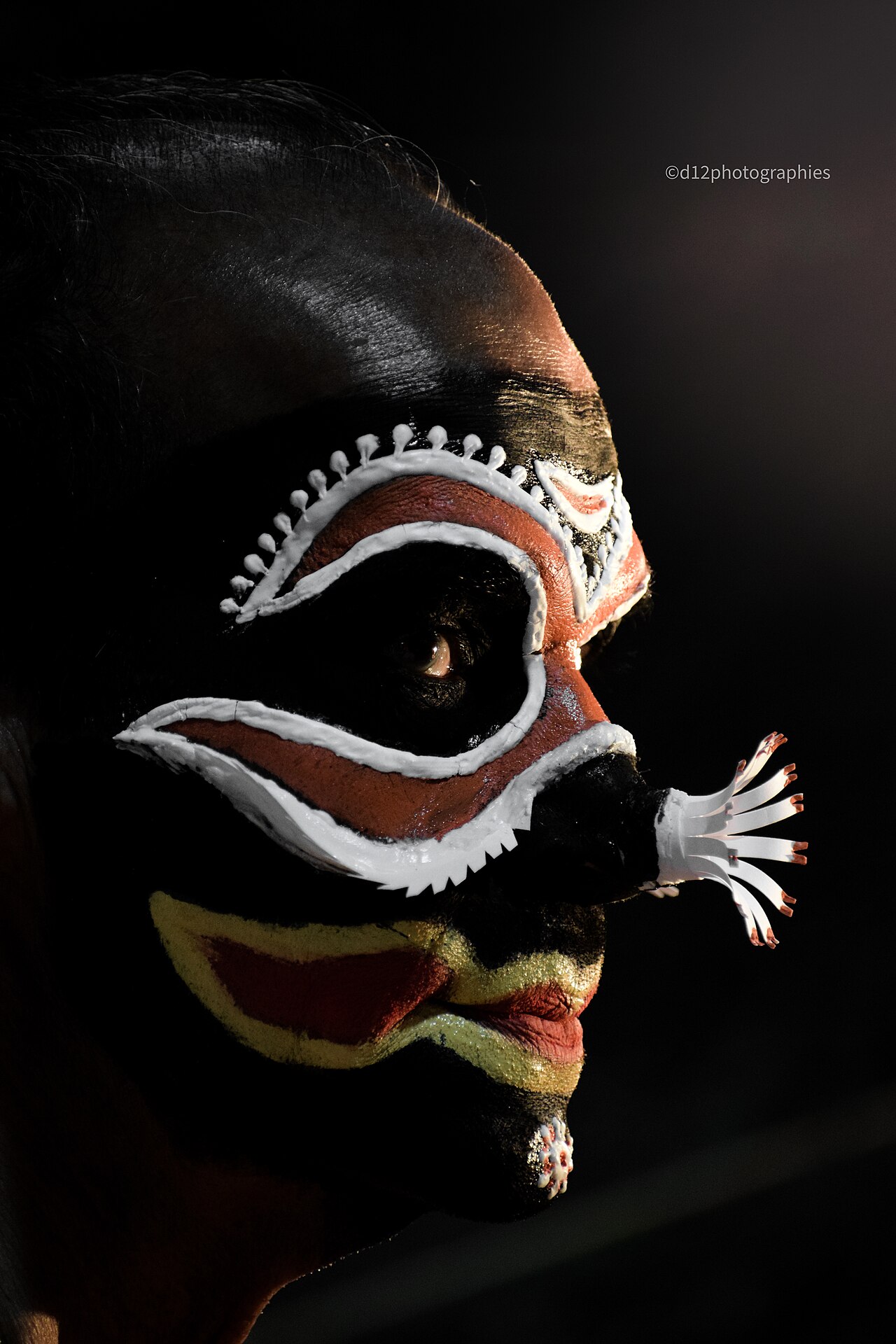
Night-long drama in painted mask-like makeup. Meaning is carried in the hands and, above all, the eyes.
About
A dance-drama performed through the night, in which the actors never speak. Everything is delivered through hand gestures, a rigorously trained face, and a body held in a wide, low, outward-turned stance. The makeup takes hours to apply and turns the face into a coloured mask that is still fully mobile.
History
Kathakali took shape in seventeenth-century Kerala, developing out of Ramanattam — a cycle of plays on the Ramayana attributed to Kottarakkara Thampuran — which in turn answered the earlier Krishnanattam. Behind both sit the much older Sanskrit theatre of Kutiyattam and the ritual performance traditions of the region, including Theyyam and Mudiyettu. The form was in decline by the early twentieth century; the poet Vallathol Narayana Menon founded Kerala Kalamandalam in 1930, which put its training on an institutional footing and is the main reason it survives.
Technique
Training begins in childhood and includes a full-body oil massage regime and specific exercises for the eyes, which must move independently and hold sustained expression at a distance. The gesture vocabulary follows the Hastalakshana Deepika, with twenty-four basic hand shapes combined into a working language. The nine rasas are drilled as discrete facial states. Character type is written directly into the makeup: pacha, green, for the noble; kathi, knife, for the arrogant anti-hero; thadi for bearded types; kari, black, for forest dwellers and demons; minukku, polished, for women and sages.
Repertoire
Plays are drawn from the Mahabharata, the Ramayana and the Puranas, staged as attakatha — texts written specifically for the form. A traditional performance runs from evening until dawn, lit historically by a single large oil lamp at the front of the stage.
Music and text
Sopanam-derived vocal style, with two singers narrating the text while the actors perform it. Percussion is heavy and central: chenda and maddalam drums, with chengila gong and elathalam cymbals.
Significance
Kathakali is the most complete surviving example of the Indian idea that theatre, dance and music are one discipline rather than three. It also carries an unusual burden of training time — a performer is not considered formed for a decade or more — which makes each break in transmission expensive to repair.
In performance
3 images