



Manipuri
Older ritual roots; Vaishnava Ras Leela from the 18th century
- State
- Manipur
- Of eight
- 06 / 8
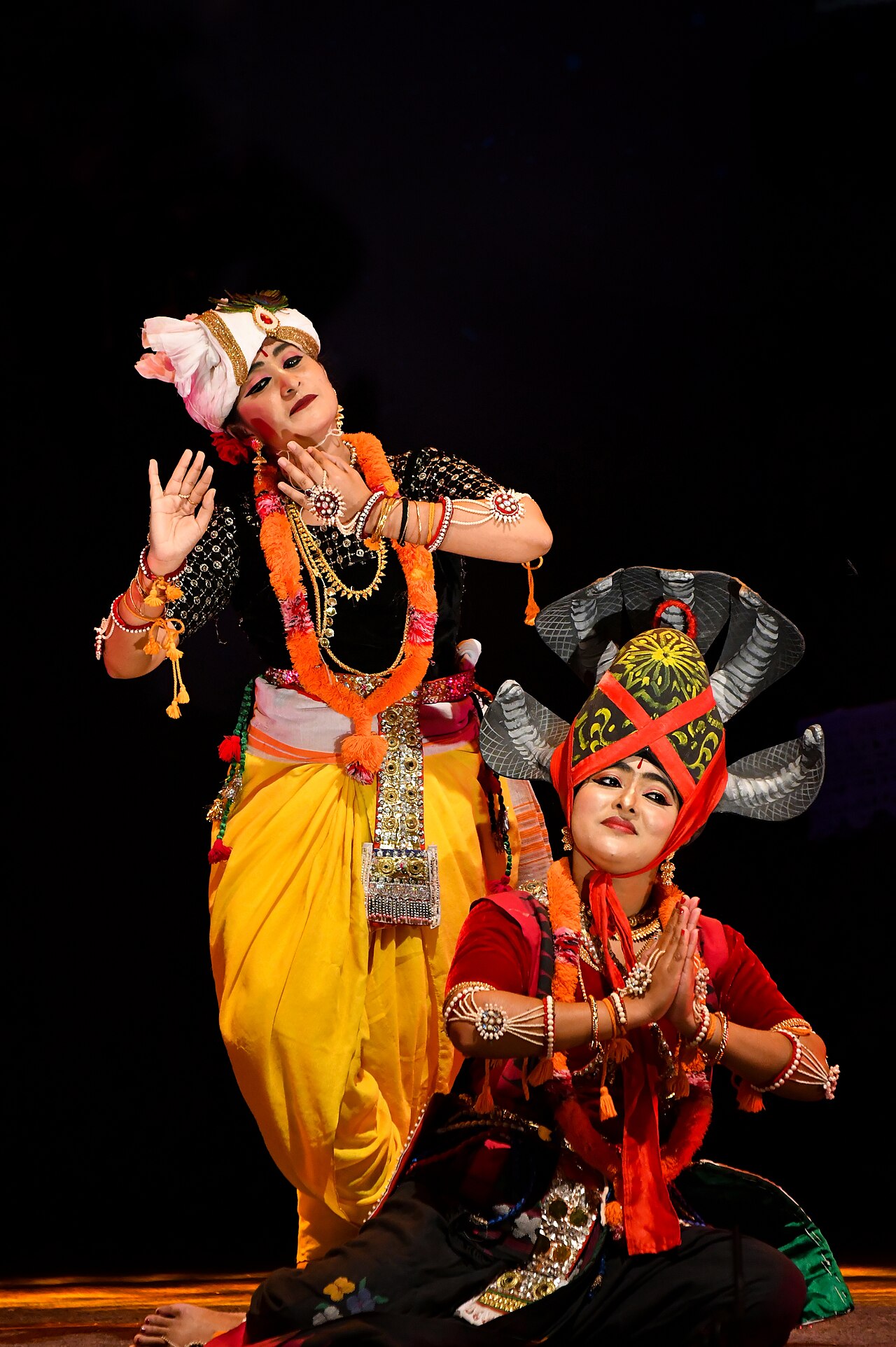
Devotional and continuous, avoiding sharp accent; the drum and the dancer are often the same person.
About
A form that deliberately refuses emphasis. Manipuri moves in continuous curves with no hard stop and no struck accent, the feet placed rather than stamped. It is danced as worship rather than as display, and its costume — a stiffened, barrel-shaped skirt — is unlike anything else in the classical repertoire.
History
Behind the Vaishnava repertoire sits Lai Haraoba, a much older ritual cycle of Manipur predating the arrival of Vaishnavism. The Ras Leela tradition took its present shape in the eighteenth century under King Bhagyachandra, who is credited with establishing the principal ras forms. Rabindranath Tagore invited a Manipuri teacher to Santiniketan in 1919, which brought the form to national attention and began its life outside the valley.
Technique
Movement is continuous and rounded, with the weight kept soft and transitions hidden; the aesthetic avoids the angular attack of the other classical forms. Men's repertoire includes vigorous drum and cymbal dances performed while playing the instrument, so that the performer is simultaneously dancer and musician.
Repertoire
Ras Leela cycles on Radha and Krishna, performed at fixed points in the ritual calendar, form the core. Alongside them stand pung cholom, danced while playing the pung drum, and kartal cholom with cymbals. Lai Haraoba material remains in ritual use.
Music and text
Devotional song in Manipuri and Sanskrit, with the pung (a barrel drum) at the centre, plus cymbals and voice. The dancer's own drumming is frequently part of the choreography rather than accompaniment to it.
Significance
Manipuri holds two religious layers in one practice — a pre-Vaishnava ritual tradition and the Krishna devotion laid over it — without collapsing either. It is also the strongest counter-example to the idea that classical Indian dance is defined by rhythmic attack.
In performance
3 images