
Mohiniyattam
Codified in the 19th century; revived from 1930
- State
- Kerala
- Of eight
- 07 / 8
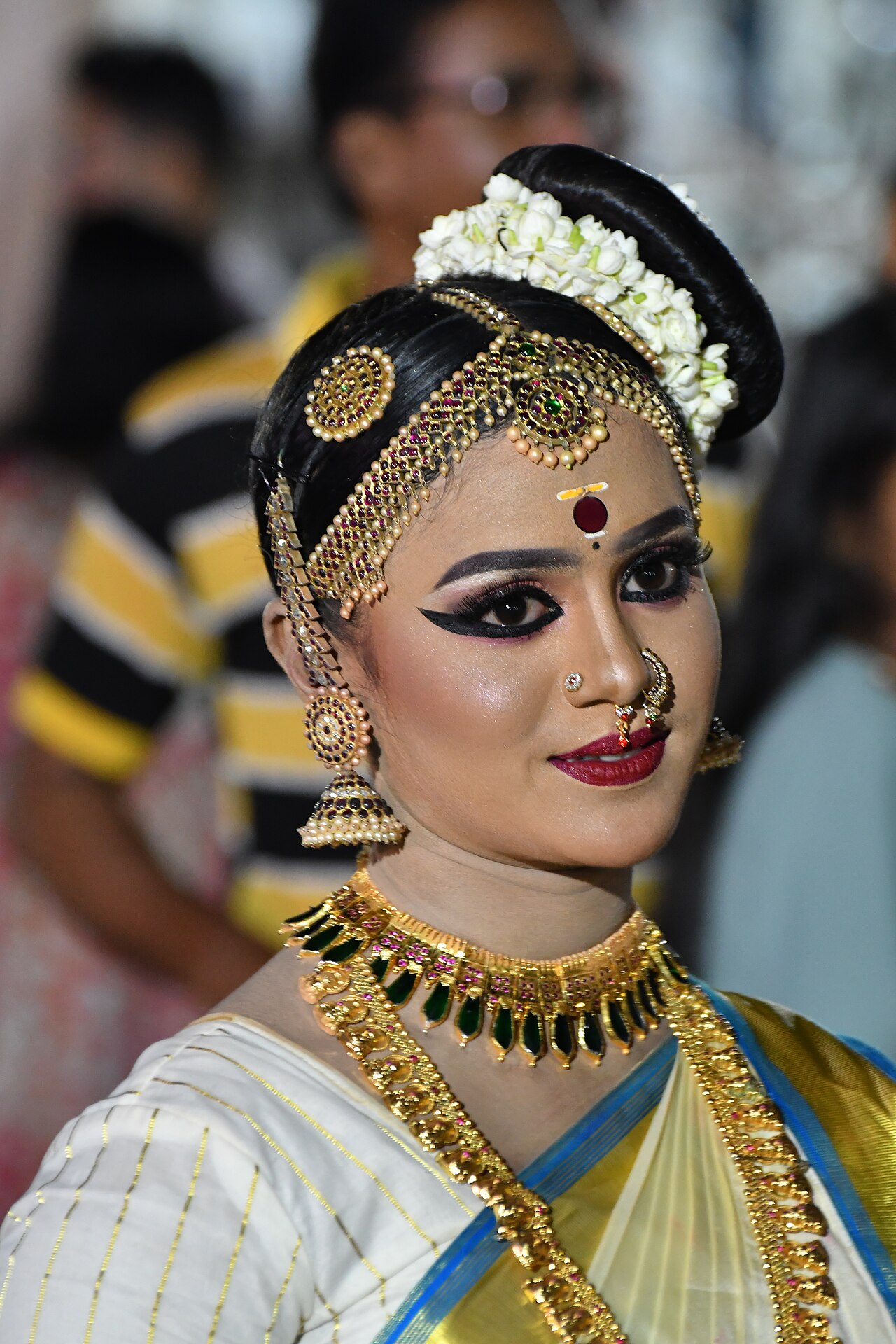
A solo form of swaying, circular movement, named for the enchantress Mohini.
About
A solo form built on sway. The torso moves in continuous circles and figures of eight while the feet keep a quiet, gliding rhythm, producing a line that never fully arrests. It is danced in off-white cloth with a gold border, and its name refers to Mohini, the form Vishnu takes as an enchantress.
History
References to the form appear by the eighteenth century, and it was given structure under Maharaja Swathi Thirunal of Travancore in the early nineteenth, whose compositions remain in the repertoire. It declined afterwards and was in a poor state by the early twentieth century. Vallathol Narayana Menon added it to the curriculum at Kerala Kalamandalam after 1930, and later teachers — Kalamandalam Kalyanikutty Amma among them — did much of the work of reassembling a coherent syllabus.
Technique
The defining quality is andolika, a swaying movement carried in the torso and hips, with circular pathways in the upper body. Footwork is soft and sliding rather than percussive. Expression is close-range and understated compared with Kathakali, though both come from the same region and share gesture vocabulary.
Repertoire
A recital runs through items broadly parallel to other southern forms — cholkettu, jatiswaram, varnam, padam, tillana — with the expressive items given unusual weight relative to pure rhythm.
Music and text
Sopanam-influenced vocal style with Carnatic structure; idakka and mridangam, veena and flute. Texts are often in Manipravalam, a blend of Malayalam and Sanskrit.
Significance
Mohiniyattam is the counterweight to Kathakali within a single regional culture: where one is loud, masked, male and nocturnal, the other is quiet, bare-faced, solo and close. Together they show how wide a range one performance tradition can hold.
In performance
3 images